Select Language:
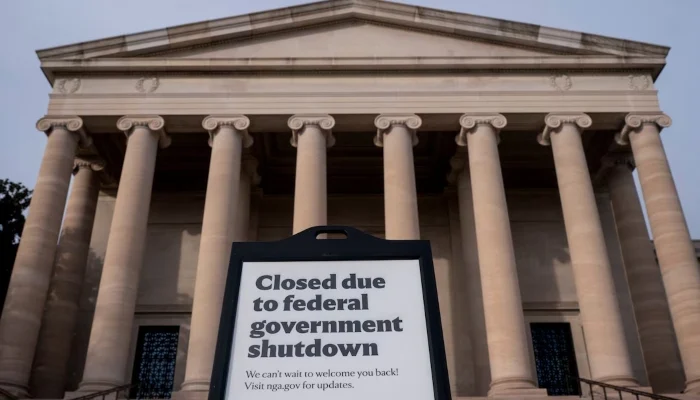
A signage warns of closures due to the ongoing U.S. government shutdown outside the National Gallery of Art in Washington, D.C., on November 7, 2025, marking more than a month since the shutdown began.
The bill encompasses three appropriations measures. Democrats opposed the funding without provisions for healthcare repairs. Meanwhile, President Trump advocates for direct payments to individuals instead of subsidies under the Affordable Care Act (ACA).
Washington: On Sunday, the U.S. Senate took a step toward reopening the federal government and ending a 40-day shutdown that has halted federal work, delayed food assistance, and disrupted air travel. Senators advanced a measure passed by the House that will be amended to extend government funding through January 30 and incorporate three full-year appropriations bills. If approved in the Senate, the revised bill still needs House approval and the president’s signature, a process that could take several days.
An agreement with some Democrats allowed a December vote on extending ACA subsidies, which have been a Democratic priority during the deadlock. The proposal also aims to reverse some of the Trump administration’s mass layoffs of federal employees and fund food assistance for a year.
“All federal employees, including military personnel, Coast Guard members, Capitol Police officers, Border Patrol agents, TSA screeners, and air traffic controllers, will be paid their back wages,” said Senator Susan Collins, chair of the Senate Appropriations Committee. The deal was negotiated by Senators Maggie Hassan and Jeanne Shaheen of New Hampshire and Angus King, an independent from Maine. Senate Minority Leader Chuck Schumer, the chamber’s top Democrat, opposed the measure.
This Sunday marked the 40th day of the shutdown, which has affected federal employees, food aid programs, national parks, and travel. Air traffic control staffing shortages threaten to disrupt travel during the busy Thanksgiving holiday later this month.
North Carolina Republican Senator Thom Tillis noted that the mounting impacts of the shutdown are bringing the Senate closer to an agreement: “Temperatures are cooling, the atmospheric pressure is rising outside, and it looks like things are starting to come together.”
Prolonged government closure could lead to negative economic growth in the fourth quarter, especially if air travel doesn’t normalize by Thanksgiving, warned White House economic advisor Kevin Hassett on CBS’s “Face the Nation.” Thanksgiving falls on November 27 this year.
President Trump Criticizes Healthcare Subsidies
Amid the Capitol Hill negotiations, Trump reiterated his push to replace ACA subsidies with direct payments to individuals, claiming that current subsidies benefit health insurance companies and are disastrous for Americans. He stated his readiness to collaborate across parties once the government is reopened.
Treasury Secretary Scott Bessent and Senator Lindsey Graham emphasized that Trump’s healthcare proposal would not be introduced until the budget deal is reached. Bessent mentioned on ABC’s “This Week” that negotiations with Democrats would commence only after government funding is restored.
As the enrollment period for 2026 ACA health plans approaches, experts warn that premiums are expected to more than double on average, as pandemic-era subsidies expire at year’s end.
Republicans rejected a Democratic proposal to reopen the government in exchange for a one-year extension of ACA tax credits. Democratic Senator Adam Schiff accused Trump’s healthcare plan of aiming to weaken the ACA and enable insurers to deny coverage for pre-existing conditions, criticizing that it would empower insurance companies to cancel policies or refuse coverage based on health history.
 ChatGPT
 Perplexity
 Gemini AI
 Grok AI