Select Language:
The United States has confiscated a sanctioned oil tanker off the coast of Venezuela, President Donald Trump announced on Wednesday. This action caused oil prices to climb and significantly heightened tensions between Washington and Caracas.
“We just seized a large tanker near Venezuela—actually the largest one ever—and other developments are underway,” Trump stated, reaffirming his administration’s continued pressure on Venezuelan President Nicolás Maduro to resign. When asked about the fate of the oil, Trump responded, “I guess we’ll keep it.”
This incident marks the first known seizure of a tanker since the U.S. increased its military presence in the region. Previously, the U.S. had conducted strikes against suspected drug vessels, raising legal and ethical concerns among lawmakers and experts.
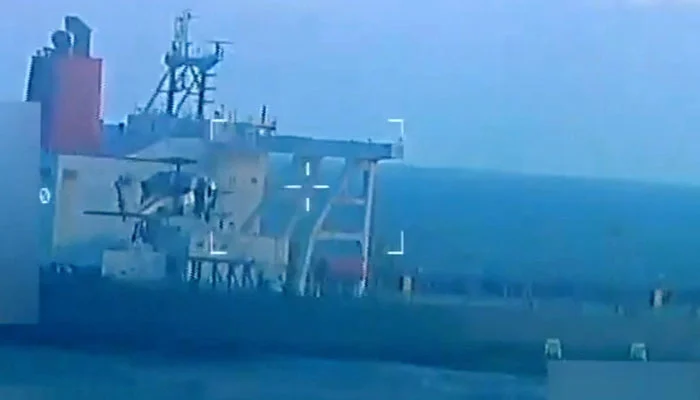
U.S. Attorney General Pam Bondi shared on X (formerly Twitter) that the FBI, Homeland Security, Coast Guard, and military forces executed a warrant to seize a crude oil tanker involved in transporting sanctioned oil from Venezuela and Iran. A short video released by Bondi depicted two helicopters approaching a vessel, with armed personnel rappelling onto it.
The vessel’s identity has not been officially disclosed by the Trump administration. However, British maritime risk analysts believe the tanker Skipper was seized early Wednesday off Venezuela. Previously, the tanker, called Adisa, was involved in Iran-Venezuela oil trades and had left Venezuela’s main port, Jose, after loading roughly 1.1 million barrels of heavy crude according to satellite data and shipping records.
Oil futures responded positively to the news. Brent crude climbed 27 cents (0.4%) to close at $62.21 per barrel, while U.S. West Texas Intermediate futures increased by 21 cents (0.4%) to finish at $58.46.
Venezuela’s President Maduro addressed a military march Wednesday, avoiding topics related to the seizure. The country’s oil exports last month averaged over 900,000 barrels per day, the third-highest monthly total this year, despite the U.S. sanctions that have driven Venezuela to sell heavily discounted crude, particularly to China. Competition from Iran and Russia has further pressured prices.
Analyst Rory Johnston commented that the seizure exacerbates existing concerns about oil supply but doesn’t drastically change the overall situation because these barrels were already in transit or stored. Meanwhile, Chevron, a key partner with Venezuela’s state oil company PDVSA, reported no disruption in its operations, which include exports to the U.S.
Maduro alleges that the U.S. military buildup aims to overthrow his government and seize Venezuela’s substantial oil reserves. Since early September, the U.S. has conducted more than 20 strikes targeting suspected drug vessels in the Caribbean and Pacific, reportedly killing over 80. Critics argue these strikes are illegal, as they lack transparent evidence and involve lethal force that could have been replaced with seizure and interrogation.
Public opinion polls indicate that many Americans oppose these aggressive tactics, with about 20% of Trump’s Republican supporters expressing disapproval. Last week, Trump’s foreign policy strategy emphasized reasserting American dominance in the Western Hemisphere.
 ChatGPT
 Perplexity
 Gemini AI
 Grok AI