Select Language:
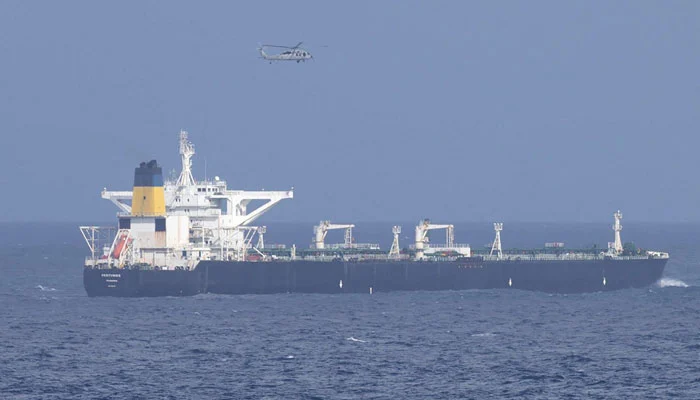
A U.S. military helicopter flies over the Panama-flagged vessel Centuries, which was intercepted by the U.S. Coast Guard a few days after President Donald Trump announced a blockade targeting all sanctioned oil tankers moving in and out of Venezuela, east of Barbados in the Caribbean Sea on December 20, 2025. — Reuters
The Coast Guard is currently tracking an oil tanker in international waters near Venezuela, according to officials who spoke to Reuters on Sunday. This marks the second such operation this weekend and could become the third in less than two weeks if the pursuit succeeds.
A U.S. official stated, “The U.S. Coast Guard is actively pursuing a vessel that is part of Venezuela’s illegal sanctions evasion efforts. It is flying a false flag and is under a judicial seizure order.”
Another official mentioned the tanker is under sanctions but clarified it hasn’t been boarded yet. Interceptions can take many forms—such as sailing close to or flying near vessels of interest. The officials, who requested anonymity, did not specify the operation’s exact location or disclose the vessel’s name.
The White House did not immediately respond to requests for comment.
Last week, President Trump declared a “blockade” on all sanctioned oil tankers entering or leaving Venezuela. The administration’s pressure campaign against President Nicolas Maduro has included increasing military presence in the region and launching more than two dozen strikes on vessels in the Pacific and Caribbean near Venezuela. At least 100 people have been killed in these attacks.
The first two tankers seized were operating on the black market and supplying oil to countries under U.S. sanctions, said Kevin Hassett, director of the White House’s National Economic Council, in an interview on CBS’s “Face the Nation.”
“I don’t think Americans need to worry about rising prices because of these ship seizures,” Hassett said. “There are just a few ships, and they were part of the black market.”
However, a trader told Reuters that these seizures could slightly boost oil prices when Asian markets open on Monday. UBS analyst Giovanni Staunovo explained, “Prices might increase modestly at the start of trading because the market could see this as an escalation, with more Venezuelan barrels at risk since the tanker wasn’t on a U.S. sanctions list.”
Some analysts note that these operations increase geopolitical risks and could heighten tensions in the shadow fleet — the network of vessels moving oil from sanctioned countries like Venezuela, Russia, and Iran. Matias Togni, an oil shipping analyst at NextBarrel, suggested that these actions might also embolden Ukraine to attack Russian ships and could lead Europe to detain vessels linked to Moscow.
Venezuelan and Iranian oil production already shows signs of slowing, Togni added, and he anticipates similar declines for Russia. With logistics becoming costlier, oil from sanctioned nations may be sold at steeper discounts, potentially limiting gains in benchmark oil prices.
 ChatGPT
 Perplexity
 Gemini AI
 Grok AI