Select Language:
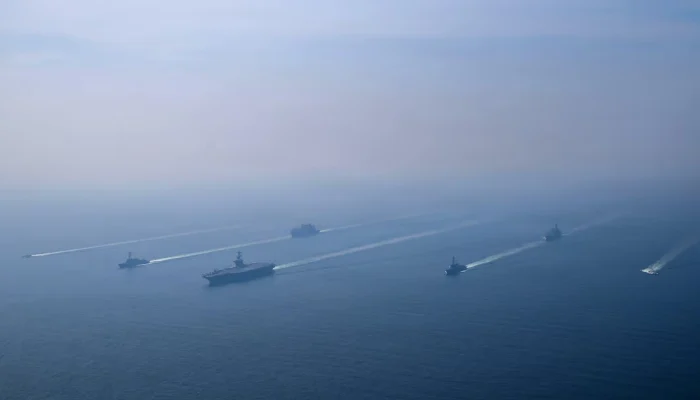
The US Navy’s Nimitz-class aircraft carrier USS Abraham Lincoln leads its strike group during a photo exercise in the Arabian Sea on February 6, 2026. — Reuters
– Trump suggests Iran might be open to negotiations.
– The US and Iran are engaging in indirect nuclear talks in Geneva.
– The US military is gearing up for possible operations against Iran.
—
GENEVA: On Tuesday, the US and Iran held indirect talks in Geneva aimed at resolving their longstanding nuclear dispute. However, there was little clear progress toward an agreement, even as Washington assembled a military force in the region.
US representatives Steve Witkoff and Jared Kushner participated in negotiations mediated by Oman, according to a source familiar with the matter. Iranian Foreign Minister Abbas Araqchi was also involved.
President Donald Trump stated he would be indirectly involved in the Geneva talks and expressed optimism that Tehran is interested in reaching a deal.
“I don’t believe they want the consequences of not making a deal,” Trump told reporters aboard Air Force One on Monday. “We could have secured a deal instead of deploying B-2 bombers to disable their nuclear capabilities. They knew that.”
Iran is aware that a previous effort to restart negotiations was underway last June when Israel launched a bombing campaign against Iranian targets. US B-2 stealth bombers also struck nuclear-related sites. Since then, Tehran claims to have halted uranium enrichment beyond civilian requirements.
Meanwhile, the US military is preparing for potential prolonged operations against Iran if ordered by Trump, according to two US officials.
Iran responded by launching a military exercise on Monday in the Strait of Hormuz, a critical waterway for Shia-led Gulf Arab oil exports, with regional leaders urging diplomacy to de-escalate the tensions.
—
Tehran and Washington resumed negotiations on February 6 to address their decades-long nuclear disagreements.
Iranian Foreign Minister Abbas Araqchi met with International Atomic Energy Agency (IAEA) Director General Rafael Grossi in Geneva on February 16. Iran maintains its nuclear program is peaceful, despite enriching uranium to levels close to those required for a bomb, while the US and Israel contend Iran seeks nuclear weapons to threaten Israel’s existence.
Since the June missile strikes, Iran’s government has faced widespread protests, which they have suppressed at significant cost. These protests are driven by economic hardship worsened by international sanctions that restrict Iran’s oil revenue.
Unlike previous efforts, the US has now positioned a substantial naval fleet in the region, a move President Trump describes as “massive.”
The US aims to broaden negotiations to include non-nuclear issues like Iran’s missile arsenal, although Tehran insists it will only discuss limits on its nuclear activities in exchange for sanctions relief. Iran refuses to completely denuclearize or negotiate its missile program.
On Monday, US Secretary of State Marco Rubio told reporters in Budapest that although a deal with Iran is difficult, the US remains open to trying.
On the same day, Araqchi met with Grossi to explore cooperation with the IAEA and technical matters ahead of upcoming discussions with the US.
Later, Witkoff and Kushner will join a three-party dialogue with Russia and Ukraine in efforts to mediate an end to Moscow’s four-year invasion of Ukraine, according to sources.
 ChatGPT
 Perplexity
 Gemini AI
 Grok AI