Select Language:
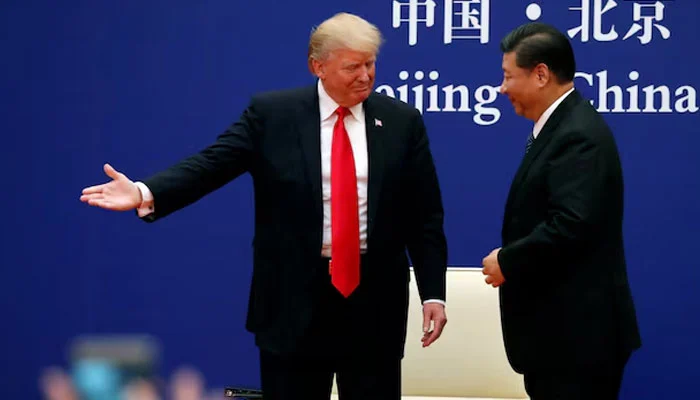
Top US and Chinese financial officials are preparing for a fresh round of negotiations in Paris this Sunday. The goal is to smooth out issues in their trade truce and pave the way for President Donald Trump’s upcoming meeting with Chinese President Xi Jinping in Beijing at the end of March.
Led by US Treasury Secretary Scott Bessent and Chinese Vice Premier He Lifeng, the talks are expected to zero in on adjusting US tariffs, facilitating the flow of Chinese rare earth minerals and magnets into the US, American restrictions on high-tech exports, and Chinese commitments to purchase US agricultural products.
The negotiations will take place at the Paris headquarters of the Organization for Economic Cooperation and Development, a group more familiar to wealthy democracies, as China considers itself still developing.
US Trade Representative Jamieson Greer will join the discussions, continuing a series of meetings held across Europe last year aimed at easing tensions that nearly crippled trade between the two largest economies.
Trade analysts from both countries say the chances of reaching a major breakthrough are slim, especially since Washington’s focus is currently diverted by the ongoing US-Israeli conflict with Iran. The limited time for talks further diminishes prospects for significant agreements either in Paris or in Beijing.
Many believe that both sides are primarily interested in simply maintaining dialogue to prevent tensions from escalating further. “As far as Trump is concerned, his objective in Beijing might be to secure large Chinese orders for Boeing aircraft and increased purchases of US natural gas and soybeans,” commented Scott Kennedy, a China economic expert at the Center for Strategic and International Studies in Washington. However, this may require concessions from the US on export controls.
Kennedy also expressed skepticism, suggesting the upcoming meetings might produce only superficial signs of progress, leaving things largely unchanged from the past few months. There’s a possibility that President Trump and Xi could meet three more times this year—potentially during the APEC summit in China in November and the G20 summit in the US in December—where more tangible breakthroughs might be possible.
Regarding the broader geopolitical context, discussions in Paris are likely to address the impact of the US and Israel’s stance toward Iran, particularly given recent increases in oil prices and concerns over the closure of the Strait of Hormuz, a crucial passage through which China sources about 45% of its oil. Recently, US officials announced a temporary suspension of certain sanctions to enable the sale of Russian oil stranded at sea and have called for international assistance in safeguarding shipping through the Hormuz Strait following recent US military strikes on Iranian targets and threats of retaliation from Iran.
Amid these tensions, China’s state-run Xinhua news agency noted that progress in US-China economic cooperation could help restore confidence in the fragile global economy.
The negotiations will also revisit the commitments made under the October 2025 trade truce declared by Trump and Xi in South Korea, which temporarily eased tensions, reduced certain tariffs, and halted China’s aggressive export restrictions on rare earths for a year. China also agreed to purchase 12 million metric tons of US soybeans in the 2025 season and 25 million tons in the following year.
While some US industries currently benefit from Chinese exports of rare earths—crucial for manufacturing high-tech goods—others, particularly in aerospace and semiconductors, face shortages of key materials like yttrium used in jet engines.
In the short term, US officials are likely to focus on increasing Chinese purchases of US agricultural products and gaining broader access to Chinese rare earth resources.
Adding complexity to the talks, new investigations by the US government—under Section 301—are examining China and other major trading partners for alleged unfair trade practices, such as excess industrial capacity. These probes could lead to renewed tariffs within months and also target forced labor practices in dozens of countries, including China, risking further trade disruptions.
China has criticized these investigations and warned of possible countermeasures. An editorial in China Daily described the probes as unilateral actions complicating negotiations, emphasizing the importance of Washington adopting a pragmatic approach to stabilize economic relations with Beijing.
 ChatGPT
 Perplexity
 Gemini AI
 Grok AI