Select Language:
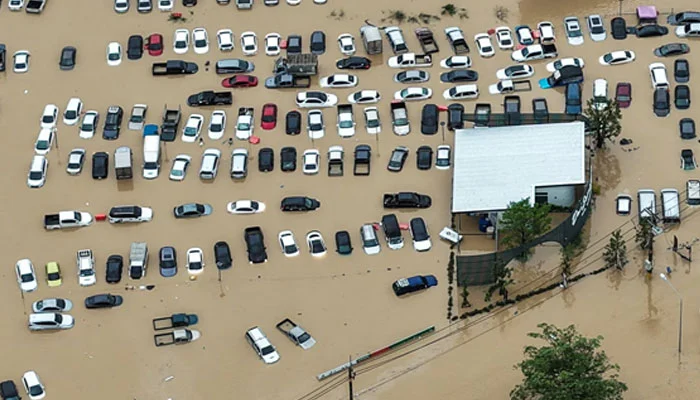
A drone captures an aerial view of cars parked in a flooded area in Hat Yai district, Songkhla province, Thailand, on November 25. — Reuters
– Sri Lanka declares a state of emergency and appeals for international assistance.
– Over 631 people have died, with 472 still missing across Sumatra, Indonesia.
– Witnesses describe sudden, tsunami-like flood surges.
Flood response teams and aid agencies in Indonesia and Sri Lanka are racing to deliver supplies Tuesday to hundreds of thousands stranded after catastrophic flooding that has resulted in approximately 1,200 deaths across four nations.
Heavy monsoon rains combined with two tropical cyclones last week dumped substantial rainfall over Sri Lanka, parts of Sumatra in Indonesia, southern Thailand, and northern Malaysia.
Climate change is intensifying such weather events, as a warming atmosphere retains more moisture and rising sea temperatures strengthen storm systems.
While floodwaters have mostly receded, the destruction has left countless people displaced, living in shelters, struggling to access clean water and food.
In Aceh, one of the worst-hit regions of Indonesia, residents report that survivors who could afford it are hoarding supplies.
“Roads are mostly blocked in flood-affected zones,” said 29-year-old Erna Mardhiah, standing in line at a gas station in Banda Aceh.
“Everyone’s worried about running out of fuel,” she added after waiting for two hours.
Prices have soared due to the shortages.
“Things are already expensive—chili peppers cost up to 300,000 rupiah per kilo ($18)—which probably explains the panic buying,” she explained.
On Monday, Indonesia announced it would send 34,000 tons of rice and 6.8 million liters of cooking oil to the hardest-hit provinces: Aceh, North Sumatra, and West Sumatra.
“There’s no room for delay,” stated Agriculture Minister Andi Amran Sulaiman.
Food scarcity remains a major concern, with aid groups warning that local markets are rapidly running out of essential supplies, with prices already tripling.
“Communities across Aceh face severe food shortages and hunger if supply lines aren’t restored within a week,” said Islamic Relief.
A shipment of 12 tons of food, coordinated with Indonesia’s navy, is expected to arrive in Aceh Tuesday.
In Sumatra, the floods have caused over 631 deaths, with 472 people still missing. Affected populations have totaled around a million people who’ve evacuated their homes, according to disaster officials.
Survivors describe overwhelming waves of water that struck without warning.
In East Aceh, Zamzami described the floodwaters as “unstoppable, like a tsunami.”
“We can’t explain how enormous the water was. It was truly extraordinary,” said the 33-year-old, who goes by a single name.
People in his village took refuge atop a local two-story fish market to escape the deluge and are now trying to clear mud and debris amid ongoing power and communication outages.
“Access to clean water is difficult,” he told AFP on Monday. “Children are starting to get fevers, and there’s no medicine.”
The same weather system caused heavy rain in southern Thailand, killing at least 176 people, while neighboring Malaysia reported two fatalities.
In Sri Lanka, heavy rains triggered flash floods and deadly landslides, claiming at least 390 lives. An additional 352 people are reported missing, and some of the worst areas in the central part of the country remain hard to reach.
President Anura Kumara Dissanayake has declared a state of emergency, describing this as “the most challenging natural disaster in our history.” Unlike Indonesia, Sri Lanka has called for international aid.
The country’s air force, with help from Indian and Pakistani counterparts, has been evacuating stranded residents and delivering vital supplies.
In Welimada, a mountainous region, authorities recovered the bodies of 11 residents buried under mudslides on Monday.
Meanwhile, in Colombo, floodwaters are slowly receding on Tuesday, after rising swiftly and surprising residents accustomed to seasonal flooding.
“Every year we have minor floods, but this was something else,” said delivery driver Dinusha Sanjaya. “It wasn’t just the amount of water, but how quickly everything went under.”
Despite a decrease in rainfall, landslide warnings remain in effect across much of the central region, local officials said.
 ChatGPT
 Perplexity
 Gemini AI
 Grok AI