Select Language:
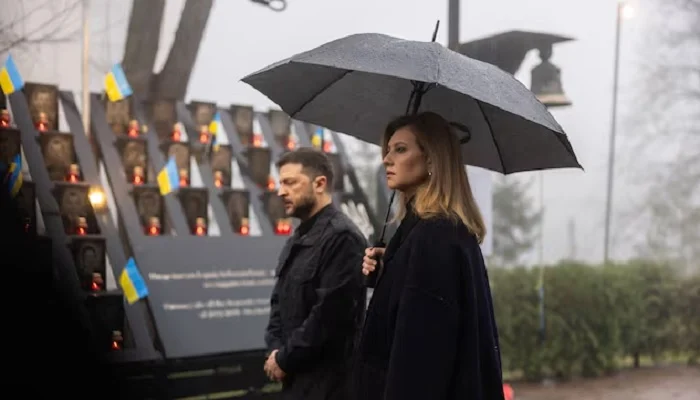
Ukraine’s President Volodymyr Zelensky and his wife Olena attended a memorial event in Kyiv on November 21, 2025, as reported by Reuters.
In recent developments, former President Donald Trump announced that the United States has set a one-week deadline for Kyiv to accept a proposed peace plan. According to sources, Zelensky and European officials are working on a counter-proposal, while Russian President Vladimir Putin has stated he has received the U.S. proposal but believes it requires further discussion.
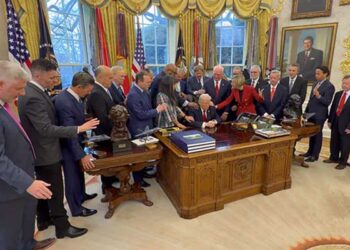
Zelensky cautioned that Ukraine faces losing its dignity and independence—or its crucial US support—over a peace initiative that includes concessions to Russia, demanding Kyiv accept key Russian conditions within a week. Trump told Fox News Radio that Thursday was a suitable deadline for Kyiv’s decision, aligning with information from two unnamed sources to Reuters. Later, Trump emphasized that time was pressing due to winter approaching and the ongoing conflict, stating Zelensky must approve the plan. He added, “He’ll have to like it, and if he doesn’t, they should just keep fighting, I guess,” and recalled a past tense exchange with Zelensky in the Oval Office, implying Kyiv didn’t have the necessary leverage.
The U.S. outlined a 28-point plan that urges Ukraine to cede territory, limit military capabilities, and forego NATO membership. It also includes terms that Moscow may oppose, such as a pullback of Russian forces from certain territories, as per a leaked draft.
Russia’s leader, Vladimir Putin, indicated that the U.S. proposal could serve as a foundation for resolving the nearly four-year-old conflict. He mentioned that Kyiv rejects the plan but claimed neither Kyiv nor Europe fully grasps Russian advances on the ground.
Zelensky, who has previously labeled the plan as a form of capitulation, called on Ukrainians to stay united and vowed to never betray Ukraine. “Ukraine faces a tough choice—either sacrificing dignity or risking the loss of a major partner,” he said, emphasizing his dedication to defending Ukraine’s dignity and freedom.
Sources told Reuters that Washington had warned it might cut intelligence and weapon aid if Ukraine refused the deal. However, a U.S. official later clarified that no such threats had been made. Zelensky has publicly maintained a cautious stance, discussing the peace plan with leaders from Britain, Germany, France, and the U.S., and agreed with Vice President JD Vance to explore feasible pathways to peace.
Zelensky expressed appreciation for U.S. efforts and mentioned ongoing discussions to develop a plan ensuring genuine and dignified peace. Experts warn that an unfavorable agreement could destabilize Ukraine after nearly four years of conflict. Tim Ash from Britain’s Chatham House predicted significant political and social upheaval if Kyiv accepts what he describes as a one-sided deal favoring Russia.
Meanwhile, German Chancellor Friedrich Merz, in a confidential call with Trump, agreed on next steps at the advisor level. The peace discussions are anticipated to feature prominently at the G20 summit in Johannesburg this weekend, despite Trump’s absence.
Reports indicate Ukraine is drafting a counter-proposal with support from Britain, France, and Germany, none of whom have been consulted on the US plan and who strongly support Kyiv. European officials, including EU foreign policy chief Kaja Kallas, warn that this could be a very dangerous moment, as Russia has no legal right to concessions from Ukraine.
U.S. officials say the draft was developed after consultations with Rustem Umerov, Ukraine’s national security adviser, who previously served as defense minister. Despite claims of agreement, Umerov has denied endorsing the plan, stating his role was primarily technical.
The plan’s substance involves Ukraine withdrawing from territories in eastern Ukraine claimed by Russia, which would also relinquish smaller regions. Ukraine would be permanently barred from joining NATO, with its military capped at 600,000 troops, and NATO forces would not be stationed there. Sanctions against Russia could be gradually eased, Russia might re-enter the G8, and frozen Russian assets could be pooled into an investment fund, with some profits allocated to the U.S.
One key Ukrainian demand—robust security guarantees akin to NATO’s mutual defense—was addressed very generally in a single line: “Ukraine will receive strong security guarantees.”
 ChatGPT
 Perplexity
 Gemini AI
 Grok AI