Select Language:
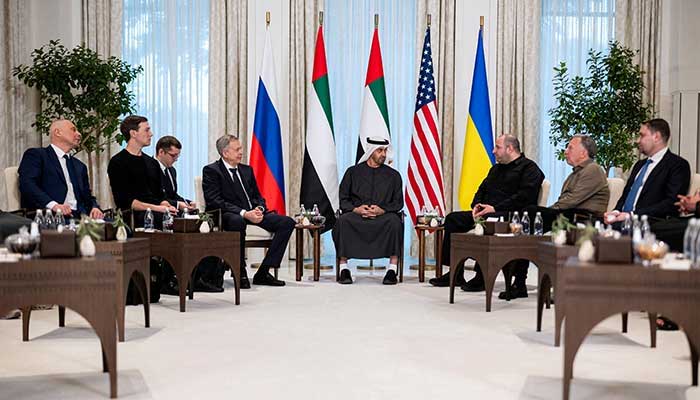
The first day of negotiations among Ukraine, Russia, and the United States wrapped up Wednesday in Abu Dhabi, with Kyiv describing the talks as “meaningful and productive.” Although no major breakthroughs were achieved during this session, Kyiv indicated discussions will continue into a second day.
This US-facilitated dialogue is part of a surge of diplomatic efforts that have yet to produce an agreement to put an end to the conflict initiated by Russia’s invasion in February 2022. The war has become Europe’s deadliest since World War II, resulting in hundreds of thousands of deaths, millions displaced within Ukraine, and significant destruction across much of the eastern and southern regions.
Amid ongoing negotiations, Russian strikes on Ukraine’s power infrastructure intensified, leaving residents in Kyiv in darkness and cold, with temperatures plummeting to -20°C. Despite these hardships, Ukraine’s top negotiator, Rustem Umerov, assured that the initial day of talks was “substantive and productive,” focusing on specific measures and practical solutions.
As discussions commenced, the Kremlin reiterated its steadfast position, insisting Kyiv must capitulate if it expects the four-year-long invasion to end. “Our stance is well known,” said Kremlin spokesperson Dmitry Peskov on Wednesday. “Until the Kyiv regime makes the appropriate decisions, the special military operation will continue,” he added, referencing Russia’s term for its military actions.
In Kyiv, Foreign Minister spokesperson Georgiy Tykhy stated Ukraine is “keen to understand the true intentions of the Russians and Americans.” The discussions primarily concern “military and military-political issues,” although specifics were not provided.
A key obstacle remains the future status of eastern Ukraine. Moscow demands that Kyiv withdraw its troops from the Donbas area, including heavily fortified cities rich in natural resources, as a prerequisite for any deal. Russia also seeks international acknowledgment that territories seized during the invasion belong to Russia. Conversely, Kyiv insists the conflict should be frozen along the current frontline and opposes unilateral withdrawals.
Former President Trump sent his familiar envoy Steve Witkoff and son-in-law Jared Kushner to press for an agreement. Russia’s lead negotiator is Igor Kostyukov, director of military intelligence and a retired naval officer who has been sanctioned by the West due to his role in the invasion.
Europe feels sidelined from the negotiations, even as France and Britain advocate for forming a peacekeeping force to potentially deploy in Ukraine following any peace deal. The EU’s ambassador to Ukraine, Katarina Mathernova, emphasized the importance of Europe participating in the negotiations as a strategic objective.
Russia currently occupies about 20% of Ukraine, but Kyiv retains control over roughly 20% of the Donetsk region. Ukraine warns that ceding territory could embolden Moscow, stressing that any agreement must effectively deter future invasions. Russia also claims control over the regions of Luhansk, Kherson, and Zaporizhzhia, with pockets of territory in at least three other eastern Ukrainian regions.
On the battlefield, Russia continues to make gains at a significant human cost, aiming to outlast Ukraine’s overstretched military. Recent Russian artillery shelling in Druzhkivka killed seven civilians, according to Ukrainian officials.
Following the first round of US-mediated talks last month, many Ukrainians remain skeptical about reaching an agreement with Moscow. Petro, a Kyiv resident, remarked, “I think it’s mostly for show. We need to prepare for the worst and hope for the best.” Meanwhile, in Moscow, some are more optimistic. Larisa, a retiree with family in Ukraine and relatives fighting on the front lines, said, “Everyone hopes this will end one day. We’ve had enough.” Anton, a 43-year-old engineer, added, “It has to stop eventually.”
 ChatGPT
 Perplexity
 Gemini AI
 Grok AI