
Select Language:
In an English seaside village, researchers are exploring options to relocate a graveyard at risk of slipping into the sea or moving a parking lot dangerously close to a cliff edge. The Coastwise project team received over £15 million ($20 million) in government funding to help adapt the coastline of North Norfolk, eastern England, to the increasing erosion caused by climate change.
However, there’s a catch: the funds can’t be used for traditional coastal defenses like sea walls or rock-filled gabions. Instead, they’re assessing strategies such as voluntary buyouts, government-backed insurance programs, replacing homes with mobile accommodations, and implementing early warning systems to alert residents when evacuation becomes necessary.
Robert Goodliffe of Coastwise explained, “It’s quite innovative—while different countries are testing various approaches, nothing quite matches this.” He added, “This will require a change in how we typically think about coastal management.”
For years, Britain and other nations relied on “holding the line” with man-made defenses to combat erosion. But as many of those defenses age and sea levels rise, experts warn it’s no longer feasible to prevent all loss of land. The UK’s Environment Agency has identified some eastern English communities—on Europe’s fastest-eroding sandy coasts—that will need to retreat and move inland.
The government’s pilot programs, including Coastwise, aim to prepare sections of the coast where defenses may no longer be viable in the future. Sophie Day, a coastal adaptation specialist involved in the project, noted, “There’s a process and funding system for building defenses, but for surrendering areas, no such method exists.”
The team hopes lessons from Norfolk, such as the complexities of exhuming graves and relocating cemeteries, can be applied elsewhere. Still, some local residents believe the government’s managed retreat policy is failing communities facing imminent danger.
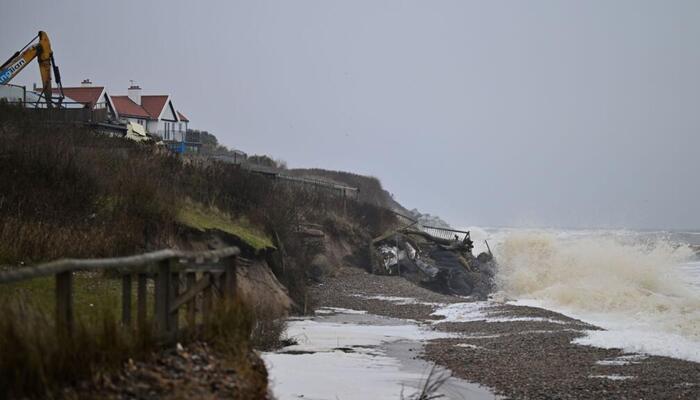
Shelley Cowlin, who lived in her Suffolk home for fifty years, saw her house demolished in January after winter storms battered the coast. “At the top of the cliff, there was this lovely, big white house… with a fantastic view,” the 89-year-old said in Thorpeness, where ten properties have been taken down since October. A storm in January destroyed a wall at her property, and gabions previously used for stabilization were washed away, with her gate swinging in the wind—tragic, she said. She criticized the government for offering no compensation for losing her home.
As Shelley spoke, workers were dismantling another house, with the government urging retreat rather than building more defenses. Her son, Simon Cowlin, expressed growing anxiety as neighboring homes disappear, asking, “When’s it my turn? … It’s a terrible place to live.”
Local councilor Katie Graham emphasized the urgency, saying, “Any defenses put in place now will only slow erosion—they won’t stop it. We need more funding and support from the government.”
Residents of Thorpeness report increasingly intense storms, aligning with scientific predictions that climate change will worsen extreme weather events. Craig Block, a boatman at the village’s lake, remarked, “It feels like the sea just lets itself in.”
Nicholas Millor, another local, described the situation as traumatic for their small community of around 130 residents and numerous holiday homes. “We’re preparing for a far more uncertain future,” he said. “What’s happening here is a microcosm of what many other communities will experience.”
Experts warn that costly traditional defenses are unlikely to halt erosion long-term. Instead, adaptation strategies like those employed by Coastwise are essential. Climate adaptation researcher Robert Nicholls called the government’s approach “deliberately experimental,” noting its potential value for other regions. “They’re trying to learn what works and what doesn’t. It’s a smart, forward-thinking approach,” he said.
 ChatGPT
 Perplexity
 Gemini AI
 Grok AI