Select Language:
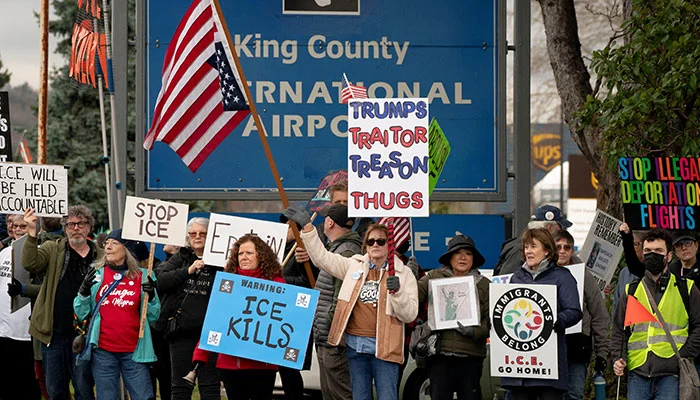
People gather at King County International Airport in Seattle, Washington, on January 15, 2026, to protest against deportation flights operated by U.S. Immigration and Customs Enforcement (ICE). — Reuters
WASHINGTON: President Donald Trump threatened Thursday to invoke the Insurrection Act to deploy the military in Minnesota amid escalating protests over increased immigration enforcement in Minneapolis.
Tensions have risen sharply since an ICE agent shot and killed a U.S. citizen, Renee Good, in a car eight days earlier, sparking demonstrations that have spread to other cities. Trump’s latest warning followed an incident where an immigrant Venezuelan man was wounded in the leg after police attempted to stop his vehicle in Minneapolis.
“If Minnesota’s corrupt politicians refuse to obey the law and stop the agitators and insurrectionists attacking ICE personnel, who are only doing their duty, I will activate the INSURRECTION ACT,” Trump posted on social media.
A Republican, Trump has repeatedly criticized Democratic leaders in Minnesota and made derogatory remarks about Somali residents, claiming they should be expelled from the country.
He has already dispatched nearly 3,000 federal officers to Minneapolis, equipped with firearms, dressed in military-style camouflage, and masked, patrolling the icy streets. Local residents have vocally protested day and night, some blowing whistles or banging drums. On Wednesday evening, crowds gathered near the site where the Venezuelan man was shot, with some shouting in protest, prompting federal agents to deploy flash-bang grenades and tear gas.
Subsequently, after most demonstrators dispersed, a small group vandalized a vehicle they believed belonged to federal officers, spray-painting it with the words: “Hang Kristi Noem,” targeting the Department of Homeland Security secretary overseeing ICE.
Since the federal crackdown began, agents have detained both immigrants and protesters, often smashing windows, forcibly removing individuals from vehicles, and stopping Black and Latino Americans to demand identification—actions that have incited public outrage.
The Department of Homeland Security identified the man involved in the shooting as Julio Cesar Sosa-Celis. He was allowed into the U.S. in 2022 under Biden’s humanitarian parole program, though the Trump administration later revoked parole for Venezuelans and other individuals admitted during Biden’s tenure.
DHS described Sosa-Celis as a convicted criminal based on Minnesota law, citing past incidents of driving without a license and providing false information to police. Court records reviewed by Reuters indicate he was only convicted of minor misdemeanors, which under state law are not considered crimes and carry a maximum fine of $300.
According to DHS, officers attempted to stop Sosa-Celis’s vehicle; he fled, crashing into a parked car before fleeing on foot. He was eventually caught, and during a struggle on the ground, two other Venezuelans emerged from an apartment and attacked a law enforcement officer with a snow shovel and broomstick.
Sosa-Celis managed to break free and hit the officer with a shovel or broomstick, prompting the officer to fire shots to defend himself. DHS officials state that both Sosa-Celis and the officer are hospitalized in recovery.
Both the Trump administration and Minnesota officials have blamed each other for fueling unrest and violence. Mayor Jacob Frey described the ICE operation as an invasion and condemned their conduct as unacceptable, emphasizing the importance of peace.
The Insurrection Act of 1807 enables the president to deploy troops or federalize the National Guard to suppress rebellion, an exception to laws restricting military involvement in law enforcement. It has been invoked 30 times in U.S. history, with courts granting the president sole authority to decide its applicability.
Trump has controversially federalized National Guard units in Democrat-controlled cities before, including last year in Los Angeles, though courts have found such actions unconstitutional. His aggressive tactics in Minnesota have divided his supporters, with 59% of Republicans supporting more aggressive arrests despite potential violence, while 39% prefer actions that minimize harm even if it results in fewer arrests, according to a recent Reuters/Ipsos poll.
Legal challenges are mounting, as Minnesota has sued the Trump administration, alleging unlawful and violent conduct by ICE agents, including racial profiling and warrantless home entries. The ACLU has filed similar lawsuits. A federal judge in Minnesota ordered the Biden administration to respond to these claims by Monday and has emphasized the importance of the case.
Both sides remain at odds, with ongoing disagreements over the escalation of immigration enforcement and federal intervention in Minneapolis.
 ChatGPT
 Perplexity
 Gemini AI
 Grok AI