Select Language:
- Fighting persists as Pakistan and Afghanistan engage in “open war”.
- Trump emphasizes having “very good relations” with Pakistan.
- The president states he holds deep respect for Prime Minister Shehbaz and Chief of Defense Munir.
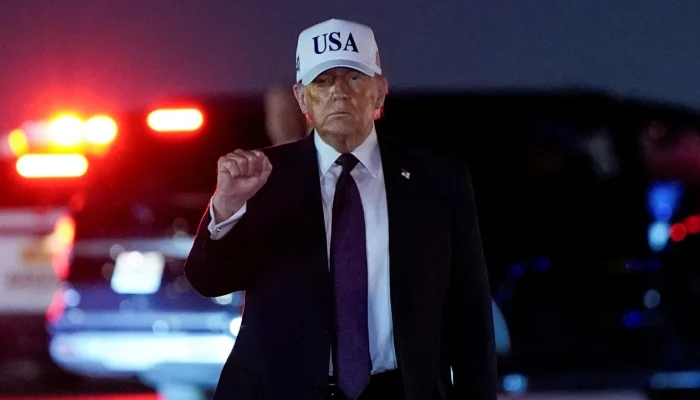
Amid ongoing border clashes between Pakistan and Afghanistan, U.S. President Donald Trump announced that Washington will not intervene in the escalating conflict between Islamabad and Kabul.
While he mentioned the possibility of stepping in, Trump highlighted the strong relations he maintains with Pakistan.
He praised Pakistan’s Prime Minister and military leader, expressing significant respect for both.
Hostilities intensified after Pakistan responded forcefully to unprovoked assaults by the Taliban regime across various sectors in Khyber Pakhtunkhwa, including Chitral, Khyber, Mohmand, Kurram, and Bajaur, on Thursday night.
In their retaliatory operation, named Operation Ghazab lil-Haq (Righteous Fury), Pakistani forces targeted and destroyed multiple Taliban positions. The Pakistani Air Force conducted strikes in Kandahar, Kabul, and Paktia, inflicting heavy losses on Afghan forces.
Reports indicate that 12 Pakistani security personnel lost their lives, with 27 injured. Pakistani authorities estimate that around 331 Taliban fighters have been killed so far.
Trump, known for proclaiming an end to numerous global conflicts, stated on Friday that the U.S. will not participate in the current fight when asked about potential intervention.
He reiterated his good ties with Pakistan, praising its leadership, including the Prime Minister and military generals.
“I could get involved, but I get along with Pakistan very well—very, very well,” he told journalists. “You have a great Prime Minister, a strong General, and a leader I deeply respect.”
He also indicated that Pakistan is making significant progress, suggesting that U.S. plans do not include interference.
U.S. supports Pakistan’s right to defend itself
The United States affirmed its support for Pakistan’s right to self-defense following Islamabad’s declaration that the two nations are in “open war.”
Afghanistan’s government expressed willingness to negotiate after Pakistan launched strikes in key cities, targeting militants linked to recent attacks.
“The United States stands by Pakistan’s right to defend itself against attacks from Taliban groups designated as global terrorists,” said a State Department spokesperson via email.
The spokesperson noted concern over rising tensions and the outbreak of battles between Pakistani forces and the Afghan Taliban, emphasizing regret over the loss of lives.
“The Taliban have repeatedly failed to meet counterterrorism commitments,” they added, emphasizing that Afghanistan continues to serve as a base for terrorist operations.
The recent spike in hostilities follows Pakistan’s counterattacks after Taliban-backed militants carried out suicide bombings in Islamabad, Bajaur, and Bannu, all traced back to Afghanistan-based groups.
Islamabad has urged Kabul to prevent its territory from being used by terrorists and conducted precise strikes against seven Taliban and Daesh-Khorasan camps along the border last week.
According to Prime Minister’s Foreign Media spokesperson, Mosharraf Zaidi, the Afghan Taliban has allowed militants to operate from their territory, which he claims breaches the Doha Agreement commitments.
The ceasefire between the two countries was first agreed upon in October 2025 after unprovoked shooting at border crossings, with subsequent efforts mediated by Qatar and Turkey, aimed at stopping Afghan-origin terrorism in Pakistan.
Despite these agreements, continued tensions have arisen from unmet commitments, with Kabul using regional talks to criticize Pakistan instead of addressing the core issue of terrorism emanating from Afghan soil.
 ChatGPT
 Perplexity
 Gemini AI
 Grok AI