Select Language:
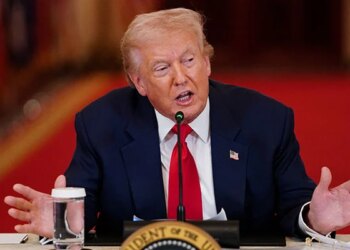
President Donald Trump announced on Monday that any country conducting trade with Iran will face a 25% tariff on all dealings with the United States, as Washington considers how to respond to Iran’s ongoing protests—its largest in years.
“Effective immediately, any nation doing business with Iran will be subject to a 25% tariff on all trades with the United States,” Trump posted on Truth Social.
U.S. tariffs are paid by American importers bringing goods from those nations. Iran has been under heavy U.S. sanctions for years.
“This directive is final and binding,” Trump added, without providing further details. Major recipients of Iranian exports include China, the United Arab Emirates, and India.
The White House has not issued official documentation about this policy on its website, nor clarified the legal authority Trump would invoke to enforce it, or if the tariffs would target all Iranian trading partners. They also did not respond to a request for comment.
Iran, which fought a 12-day war with U.S. ally Israel last year and saw its nuclear facilities bombed by the U.S. military in June, is experiencing its most intense anti-government demonstrations in recent memory.
Trump has indicated a willingness to meet with Iranian officials and claimed contact with Iran’s opposition, all while increasing pressure on Iran’s leadership, including threats of military intervention.
Tehran stated on Monday that it remains open to communication with Washington amid Trump’s deliberations on how to handle the protests in Iran, which have become a significant test of clerical rule since the 1979 Islamic Revolution.
Protests initially centered on economic hardships but have evolved into outright calls for the fall of the long-standing clerical regime. According to rights group HRANA based in the U.S., there have been verified deaths of 599 people—510 protesters and 89 security personnel—since the protests kicked off on December 28.
While airstrikes are among numerous options available to Trump, White House Press Secretary Karoline Leavitt emphasized that diplomacy remains the preferred initial approach.
Throughout his second term, Trump often threatened and imposed tariffs on countries linked to U.S. adversaries or pursuing trade policies he deemed unfair to America.
His trade policies face legal scrutiny as the U.S. Supreme Court considers invalidating a broad range of Trump-era tariffs.
As a member of OPEC, Iran exported products to 147 trading partners in 2022, according to the latest data from the World Bank.
 ChatGPT
 Perplexity
 Gemini AI
 Grok AI