Select Language:
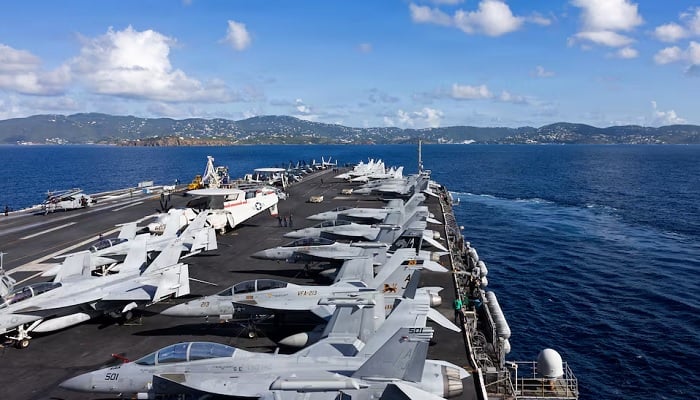
The US Navy’s nuclear-powered Ford-class aircraft carrier, USS Gerald R. Ford (CVN 78), arrived in St. Thomas, U.S. Virgin Islands, on December 1, 2025. This vessel is recognized as the world’s largest aircraft carrier, symbolizing significant military strength.
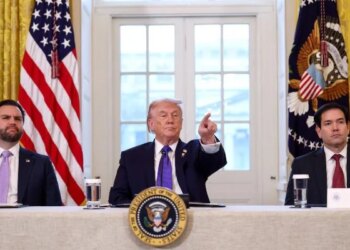
President Donald Trump publicly expressed support for the possibility of regime change in Iran, stating that “tremendous power” will soon be present in the Middle East. Concurrently, the Pentagon dispatched a second aircraft carrier to the region, reinforcing US military presence. Trump indicated that, should diplomacy fail, additional military force is ready to be utilized.
While US and Iranian officials continue efforts to restore negotiations over Iran’s nuclear program, tensions remain high. Recently, US diplomats Steve Witkoff and Jared Kushner are scheduled to meet with Iranian counterparts in Geneva on Tuesday, with Oman serving as intermediary. These talks also include discussions with Russia and Ukraine about resolving the ongoing conflict in Ukraine.
Trump responded affirmatively when asked if he favors regime change in Iran, describing it as potentially the best outcome. He refrained from specifying who should lead Iran, only mentioning that “there are people.” Trump criticized the long history of diplomatic talks, emphasizing the loss of lives during this period and advocating for more decisive action.
The US aims to include discussions on Iran’s ballistic missile activities, support for regional armed groups, and the overall treatment of Iranian citizens. Iran has signaled willingness to negotiate limits on its nuclear activities in exchange for sanctions relief but refuses to link these talks to missile concerns.
Threatening military action if negotiations stall, Trump mentioned the possibility of strikes on Iran’s nuclear facilities, with the goal of inspecting and potentially targeting remaining materials or infrastructure. Tehran has warned of retaliation, raising fears of a broader conflict as US forces increase their presence in the Middle East. Last year, the US targeted Iran’s nuclear sites with strikes.
The deployment of the USS Gerald R. Ford involves a complex logistics process. It joins the USS Abraham Lincoln, along with guided-missile destroyers, fighter aircraft, and surveillance planes stationed in the Middle East. The Ford, which is the newest and largest carrier in the US fleet, has already been operating in the Caribbean, including participation in operations in Venezuela earlier this year.
Earlier, President Trump mentioned that a second carrier had been sent “just in case we don’t make a deal,” suggesting readiness to escalate if necessary. The carrier will take approximately a week to arrive in the Middle East. Historically, the US has deployed two carriers simultaneously in the region, notably in June last year during strikes against Iranian nuclear sites.
US aircraft carriers are scarce resources, with only 11 in the fleet, often scheduled well in advance. The Ford, powered by a nuclear reactor, can carry over 75 aircraft, including F-18 Super Hornets and E-2 Hawkeyes, which provide early warning capabilities. It features advanced radar systems to facilitate air traffic control and navigation.
Support ships accompanying the carrier include the Ticonderoga-class cruiser Normandy and Arleigh Burke-class destroyers such as Thomas Hudner, Ramage, Carney, and Roosevelt, equipped for multiple warfare domains, including anti-air, anti-surface, and anti-submarine operations.
 ChatGPT
 Perplexity
 Gemini AI
 Grok AI