Select Language:
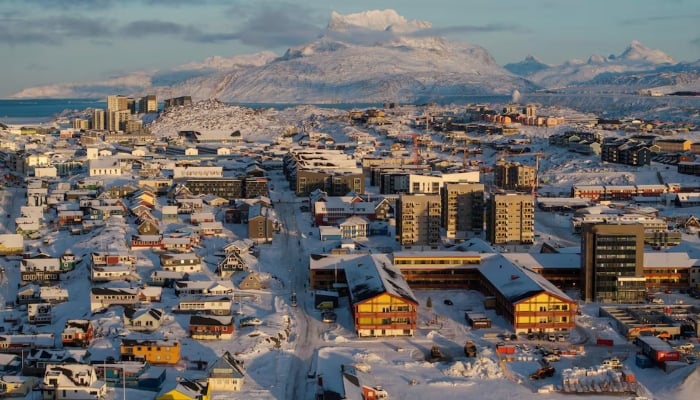
Greenland’s capital, Nuuk, was viewed from above on January 15,, 2026. — Reuters
– NATO plans to bolster its Arctic presence as part of a U.S.-led framework agreement.
– President Trump’s intentions toward Greenland are straining transatlantic relations.
– EU leaders are cautious about trusting U.S. commitments following the Greenland controversy.
President Donald Trump announced on Thursday that he secured indefinite U.S. access to Greenland through a deal with NATO, whose secretary emphasized that allies must increase their Arctic security efforts to counter threats from Russia and China.
The announcement of this framework agreement coincided with Trump relaxing tariff threats against Europe and ruling out military action to seize Greenland, easing what had been a potential major fracture in transatlantic relations.
While European markets rebounded and Wall Street neared record highs, skepticism remains about the potential damage already inflicted on transatlantic trust and business confidence.
Details of the agreement remain unclear, with Denmark asserting that its sovereignty over Greenland is non-negotiable. EU foreign policy chief Kaja Kallas remarked that relations with the U.S. have “suffered a major blow” recently, as EU nations gathered for an emergency summit.
Greenland’s Prime Minister, Jens-Frederik Nielsen, expressed cautious optimism regarding Trump’s comments but admitted he was still in the dark about many specifics.
“I don’t know what’s in the agreement or deal concerning my country,” he told reporters in Nuuk.
“Many topics are open for discussion, and we’re willing to negotiate a better partnership. But sovereignty is a red line,” he added, when asked about reports that Trump aimed for control over regions around U.S. military bases in Greenland as part of a broader deal.
On his return from the World Economic Forum in Davos, Switzerland, Trump told reporters aboard Air Force One that negotiations are ongoing for a deal that would be “much more generous to the United States—much more so.”
He declined to address sovereignty directly but emphasized: “We have to be able to do exactly what we want.”
Earlier, Trump told Fox Business Network that the agreement would essentially grant “total access” rights to the U.S.
“There’s no deadline or limit,” he said.
A source familiar with the negotiations told Reuters that NATO Secretary General Jens Stoltenberg and Trump agreed in Davos to hold further talks involving the U.S., Denmark, and Greenland to revisit the 1951 agreement governing U.S. military presence and access on the island.
The framework discussed also includes measures to block Chinese and Russian investments in Greenland.
Another insider noted that what was agreed upon was “a starting point for discussions,” emphasizing that details reported are speculative.
Rutte indicated to Reuters during Davos that NATO’s top commanders will handle the specifics of security arrangements, hoping for a swift resolution—preferably in early 2026.
Denmark insists the sovereignty of Greenland, a semi-autonomous Danish territory, remains unchanged. Prime Minister Frederiksen stated no negotiations have taken place regarding territorial sovereignty but acknowledged progress in joint Arctic security initiatives.
She also called for a “permanent NATO Arctic presence, including around Greenland.”
Kallas pointed out that disagreements between allies, such as Europe and America, only serve adversaries who are observing.
Finnish President Alexander Stubb expressed hope for a plan to enhance Arctic security by the NATO summit scheduled for July in Ankara.
British Prime Minister Keir Starmer confirmed that the UK stands ready to contribute fully to Arctic security efforts.
Following talks with Rutte, Trump suggested potential agreements that would satisfy his desires for a “Golden Dome” missile defense system and access to critical minerals, while preventing Russia and China from expanding in the region.
Rutte clarified that mineral rights were not discussed, and negotiations about Greenland’s strategic future continue directly among the U.S., Denmark, and Greenland.
The 1951 pact originally allowed the U.S. to build military bases and operate freely across Greenland, provided Denmark and Greenland are kept informed. Currently, the U.S. maintains a base at Pituffik in northern Greenland.
Marc Jacobsen, a professor at the Royal Danish Defence College, highlighted that during the Cold War, the U.S. operated 17 bases there, indicating that more extensive activities could be resumed under the existing agreement.
He added, “I anticipate concrete discussions about the Golden Dome missile system and about excluding Russia and China from Greenland.”
The EU Parliament’s president indicated that the EU might resume work on a trade deal with the U.S. now that Trump has withdrawn tariff threats. Previously, work had been paused due to those threats.
However, diplomatic sources reveal that confidence in transatlantic relations has been significantly shaken, prompting EU leaders to reassess their expectations of U.S. commitments. Many remain wary of future U.S. shifts, viewing Trump increasingly as unpredictable.
Back in Nuuk, residents are also hesitant. Pensioner Jesper Muller commented, “It’s all very confusing. One moment we’re on the brink of war; the next, everything seems fine. It’s hard to build on this instability.”
 ChatGPT
 Perplexity
 Gemini AI
 Grok AI