Select Language:
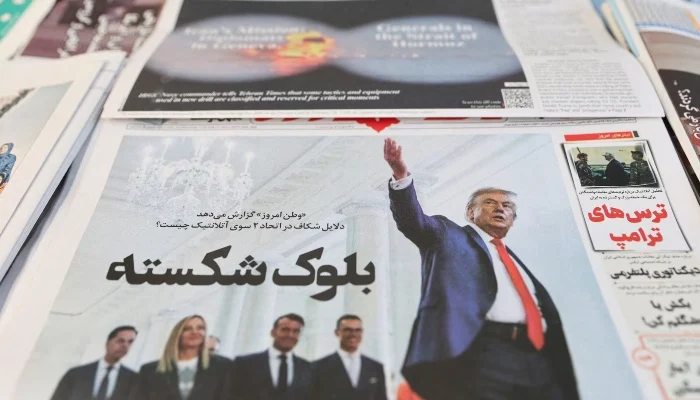
An Iranian newspaper features a cover photo of U.S. President Donald Trump in Tehran on February 17, 2026. — Reuters
WASHINGTON: President Donald Trump has pushed the U.S. closer to potential conflict with Iran, even as advisors caution him to prioritize voters’ economic concerns. This highlights the political risks associated with military escalation ahead of this year’s midterm elections.
Trump has ordered a significant buildup of forces in the Middle East and preparations for a possible multi-week aerial strike on Iran. However, he has not publicly explained why he might be leading the country into its most aggressive action against Iran since the 1979 revolution.
His focus on Iran exemplifies how foreign policy, including expanded military use, has dominated his second term’s first 13 months — often taking precedence over domestic issues like inflation and living costs, which polls show are more urgent for most Americans.
A senior White House official mentioned that, despite Trump’s tough rhetoric, there is no unified support within the administration for an attack on Iran.
His team is also aware of the importance of not sending a “distracted message” to undecided voters more concerned with the economy, the official told Reuters on condition of anonymity because they are not authorized to speak publicly.
White House advisers and Republican campaign officials stress that Trump should concentrate on the economy, especially as a private briefing this week emphasized economic issues as the top campaign priority, attended by many cabinet secretaries but without Trump present.
Another White House official, responding to Reuters questions about this story, claimed that Trump’s foreign policy efforts have “directly translated into wins for the American people.” The official added, “All of the President’s actions are America First—whether it’s making the world safer or delivering economic benefits back home.”
The November elections will determine whether Trump’s Republican Party retains control of both chambers of Congress. Losing one or both would challenge his ability to govern in his final years in office.
Rob Godfrey, a Republican strategist, warned that a prolonged conflict with Iran could be politically risky for Trump and the GOP.
“The president needs to remember the base that helped him secure the Republican nomination three times—many of whom are skeptical of foreign military involvement because ending endless war was a key campaign promise,” Godfrey explained.
Republicans plan to campaign primarily on recent tax cuts and efforts to lower housing costs and prescription drug prices.
A More Challenging Enemy than Venezuela
Despite some dissent, many supporters of Trump’s “Make America Great Again” movement backed the quick operation that ousted Venezuelan President Nicolás Maduro last month.
However, he might face more resistance if he pushes the U.S. into war with Iran, which presents a much tougher opponent.
Trump, who has repeatedly threatened to strike Iran if it doesn’t agree to limits on its nuclear program, reiterated on Friday that Tehran “better negotiate a fair deal.” The U.S. targeted Iranian nuclear sites in June, and Tehran has vowed fierce retaliation if attacked again.
Trump was reelected in 2024 largely on his “America First” platform, focusing on reducing inflation and avoiding costly foreign conflicts. Yet, polls show he’s struggling to convince Americans that he’s making progress on lowering high prices.
Supporters like Republican strategist Lauren Cooley believe Trump’s supporters might back military action against Iran if it is swift and limited.
“The White House needs to clearly link any military moves to protecting American security and economic stability at home,” she said.
Nonetheless, with little public appetite for another foreign war and Trump’s ongoing focus on economic issues, any escalation with Iran remains a gamble, especially as Trump recently admitted to Reuters that his party might face difficulties in the midterms.
Diverse Rationales for War
Foreign policy has historically played a minor role in midterm elections.
Having deployed a substantial force of aircraft carriers, warships, and aircraft to the Middle East, Trump might have limited options but to act unless Iran makes significant concessions—a move Iran has shown little willingness to pursue. Otherwise, Trump risks appearing weak on the international stage.
His reasons for potential military action have been inconsistent and vague. Initially, he threatened strikes in January in response to Iran’s violent crackdown on protests but later withdrew those threats. More recently, he tied potential military action to Iran’s nuclear program and floated the idea of regime change, though he and his officials have not clarified how airstrikes could achieve that.
A second White House official emphasized Trump’s preference for diplomacy, stating, “He has always wanted Iran to make a deal before it’s too late.” The official added that the president insists Iran “must not have nuclear weapons or the capacity to produce them, and must not enrich uranium.”
This lack of clarity contrasts sharply with President George W. Bush’s publicly stated justification for invading Iraq in 2003, which focused on eliminating weapons of mass destruction. Although that mission was based on faulty intel and false claims, Bush’s initial war goals were unambiguous.
Political strategist Godfrey pointed out that independent voters—crucial in tight races—will scrutinize Trump’s handling of Iran.
“Midterm voters and his base are watching closely to see how the president makes his case,” he said.
 ChatGPT
 Perplexity
 Gemini AI
 Grok AI