Select Language:
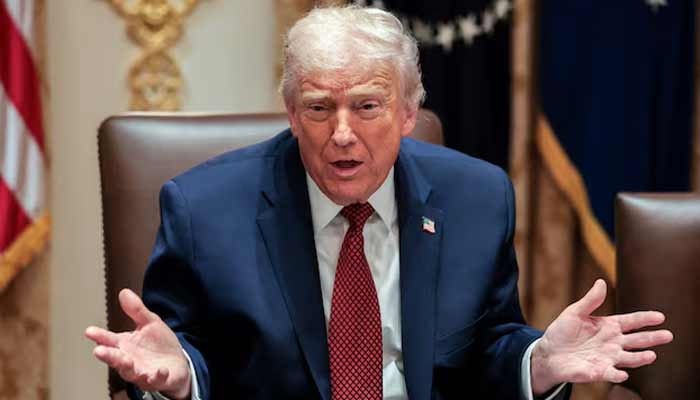
President Donald Trump indicated on Sunday that reaching a deal with Iran remains a possibility, even as Iran’s Supreme Leader warned that any U.S. attack could ignite a regional war.
In the aftermath of Iran’s severe crackdown on protests last month, Trump had threatened military responses and sent an aircraft carrier group to the Middle East.
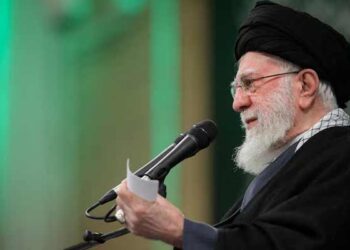
Ayatollah Ali Khamenei described recent protests as a “coup” and cautioned that a U.S. attack could expand into a larger conflict, stating, “The Americans should know that if they initiate a war, it will be a regional war.” He also encouraged Iranians not to fear Trump’s rhetoric.
Khamenei criticized protests, claiming they involved attacks on police, government buildings, Islamic Revolutionary Guard Corps (IRGC) facilities, banks, mosques, and the burning of the Quran, asserting, “It was like a coup,” which was eventually suppressed.
Regarding these warnings, Trump responded: “Of course he’s going to say that. Hopefully, we can reach an agreement. If not, we’ll see whether he was right.”
Iran released protester Erfan Soltani on bail amid rising tensions. The 26-year-old was detained in January on charges including propaganda against the Islamic regime and acting against national security. The U.S. had warned he was on death row, and threatened actions if he or others were executed. Tehran denied sentencing him to death, insisting the charges did not warrant the death penalty.
As tensions escalate, Iran’s Foreign Minister Abbas Araghchi expressed concern about “miscalculations,” but also believed Trump was “wise enough to make the right decision.” He noted Iran’s distrust of the U.S. as a negotiating partner and highlighted regional mediators working to rebuild trust.
“I see the potential for renewed talks if the U.S. follows through with President Trump’s call for a fair, equitable deal to prevent Iran from developing nuclear weapons,” he told CNN.
Iran acknowledged the deaths of nearly 3,117 protesters during the unrest, releasing a list of 2,986 names—excluding 131 individuals who are to be identified soon. Iranian officials maintain most victims were security personnel and innocent bystanders, attributing casualties to “terrorist acts.” Human Rights Activists News Agency (HRANA), based in the U.S., reports that the death toll exceeds 6,713, mostly protesters.
In response, the European Union designated Iran’s IRGC as a terrorist organization, prompting Iranian lawmakers to reciprocate by designating European armies as terrorists. Lawmakers dressed in IRGC uniforms and chanted “Death to America,” “Death to Israel,” and “Shame on you, Europe,” according to state TV footage. The immediate effects of these retaliations remain unclear. Similar designations had already been made by the U.S., Canada, and Australia.
Amid these tensions, Iranian citizens like 43-year-old homemaker Firouzeh expressed fear and worry, saying, “I constantly watch the news and wake up at night to check for updates.”
Official Iranian sources, including IRGC official Ahmad Vahidi, accused foreign enemies of stirring a “war atmosphere.” Meanwhile, Iran’s top security official, Ali Larijani, stated that despite media hype, negotiations are advancing.
President Trump confirmed ongoing diplomatic communications but kept his earlier threats in place, saying, “We’ll see what happens.” He has previously expressed belief that Iran might opt for diplomacy over military action regarding its nuclear and missile programs, and Iran has indicated preparedness for negotiations if missile and defense issues are excluded from talks.
 ChatGPT
 Perplexity
 Gemini AI
 Grok AI