Select Language:
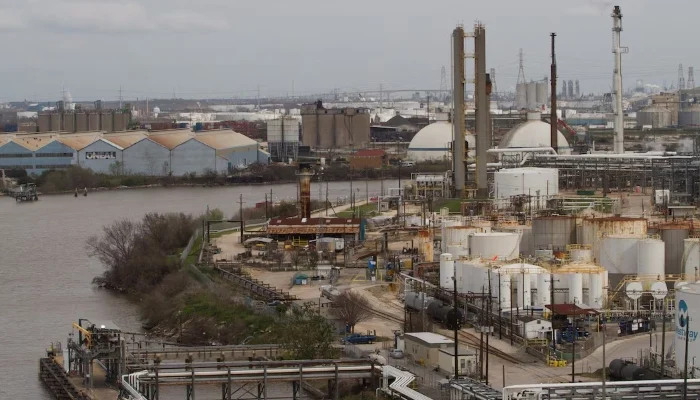
An oil refinery and storage site is shown along Buffalo Bayou, also known as the Houston Ship Channel, south of downtown Houston. — Reuters
– An Indian company plans to purchase the products produced by the new refinery.
– America First aims to begin construction in the second quarter of this year.
– Industry analysts remain skeptical about the necessity of building a new refinery on the Gulf Coast.
In a significant announcement, President Donald Trump revealed plans to build a refinery on the southern U.S. border, supported by India’s Reliance Industries, which operates the world’s largest refining complex.
Trump made the statement amid rising gasoline prices triggered by the ongoing conflict between the U.S., Israel, and Iran, and as both major political parties gear up for midterm elections that could influence congressional control during his remaining term.
“Thank you to our partners in India, and their largest privately owned energy company, Reliance, for this incredible investment,” Trump posted on Truth Social.
The proposed 168,000 barrels-per-day (bpd) refinery will be constructed at the Port of Brownsville and is expected to help reduce the U.S. trade deficit with India by approximately $300 billion, according to America First Refining.
Reliance did not respond to an email inquiry for comment.
“For the first time in 50 years, the U.S. will build a new refinery designed specifically for American shale oil,” said John V. Calce, chairman and founder of America First.
Many existing Gulf Coast refineries struggle to process light, sweet shale crude because they were designed decades ago for heavier, sour crude with higher sulfur content.
A major global oil company has committed a “nine-figure” investment valuation, with a plan to purchase the refinery’s output through a 20-year binding offtake agreement, which also aims to help reduce India’s trade surplus with the U.S., a concern frequently voiced by Trump.
America First plans to break ground in the second quarter.
Industry experts question the necessity of a new Gulf Coast refinery, considering that the region already hosts eight of the country’s ten largest refineries.
Refined Fuels Analytics Managing Director John Auers pointed out that initial proclamations of this nature tend to be overly ambitious.
Trump claims the new facility will supply U.S. markets, bolster national security, increase American energy production, generate significant economic benefits, and be the most environmentally friendly refinery worldwide.
However, Kloza Advisors Principal Analyst Tom Kloza noted that if Brownsville is indeed the construction site, it’s likely intended as an export refinery, given the limited local demand and lack of pipeline connections to distribute the product domestically.
U.S. refineries are key suppliers of motor fuel and heating oil to South America and benefit from lower natural gas, hydrogen, and domestic crude costs.
He added, “Let’s see how it develops. Reliance is a very successful company.”
Reliance’s Jamnagar complex in India, with a capacity of 1.4 million bpd, is the world’s largest refinery. With last year’s revenue reaching $125 billion, Reliance also operates in sectors like retail, renewable energy, digital services, media, and entertainment.
Since late 2025, two California refineries totaling 284,000 bpd in capacity have been shut down permanently due to statewide regulations targeting fossil fuel industries.
The average cost to build or expand a refinery in the past ten years has been roughly $40,000 per barrel of capacity, amounting to around $6.7 billion for a 168,000 bpd plant.
Data from the U.S. Energy Information Administration indicates that U.S. refining capacity totaled 18.4 million bpd at the end of 2024, with a gradual increase projected into the 2030s.
 ChatGPT
 Perplexity
 Gemini AI
 Grok AI