Select Language:
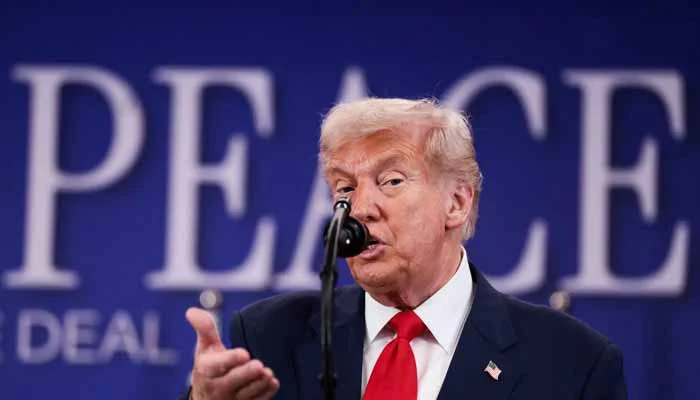
President Donald Trump predicted Friday that Iran will prefer negotiations over military confrontation, even as Tehran insists its missile program is non-negotiable.
“From what I’ve seen, Iran does want to make a deal,” Trump told reporters in the Oval Office. When asked if he had given Iran a deadline to engage in talks about its nuclear and missile activities, he confirmed “yes,” without specifying the date.
He mentioned a U.S. naval fleet heading toward Iran, stating, “We have a large armada, a flotilla—however you want to call it—on its way to Iran right now.” He expressed hope for a deal and, if not reached, indicated that “we’ll see what happens.”
Trump pointed to Iran’s decision to suspend executions of protesters, after a crackdown that rights organizations say resulted in over 6,000 deaths, as evidence that Tehran might be open to negotiations.
Regional allies are worried that a U.S. strike on Iran could destabilize the area and cause economic turmoil. An unnamed Gulf official briefed on U.S. plans said Washington remains discreet about its intentions, adding, “We hope that whatever happens leads to stability. That outcome depends on Iran doing the right thing, and we hope that’s the case.”
Meanwhile, Iran’s top security official, Secretary of the Supreme National Security Council Ali Larijani, met with Russian President Vladimir Putin in Moscow. While no details from their discussions have been made public, Russia has offered to mediate between Washington and Tehran.
Iran’s foreign minister emphasized Friday that missile and defense capabilities are “never” up for negotiation. Larijani further stated on social media that the European Union “knows” that, per Iran’s parliamentary resolution, the military of any country involved in recent EU actions against the Islamic Revolutionary Guard Corps (IRGC) will be regarded as terrorist organizations.
“The consequences of such measures will fall on European countries that initiated this move,” Larijani warned. Foreign Minister Abbas Araghchi said Iran is “prepared to begin talks if they’re on equal footing,” but added that “Iran’s defensive and missile capabilities will never be negotiated,” and no plans exist to meet with U.S. officials on resuming talks.
Nobel laureate and former IAEA head Mohamed ElBaradei condemned U.S. escalation threats, comparing them to the lead-up to the 2003 Iraq invasion, which he called “illegal and immoral” and based on falsehoods leading to devastating consequences.
Reports suggest that U.S. officials believe any agreement would need to include limits on Iran’s long-range missile arsenal, the removal of enriched uranium, and a ban on independent enrichment efforts. An expert from Ankara’s Center for Iranian Studies said linking a nuclear deal to other issues is unlikely, with Iran’s missile program remaining a key red line fundamental to its defense.
Iran has threatened swift missile retaliation against U.S. bases, ships, and allies, particularly Israel. Ali Shamkhani, head of Iran’s Defense Council, said Iran is prepared for broader, more advanced conflict scenarios.
In Istanbul, Turkish Foreign Minister Hakan Fidan accused Israel of encouraging the U.S. to attack Iran and urged Washington to prevent such action. Iran has blamed the U.S. and Israel for recent protests that started over economic grievances and escalated into what Iran describes as “riots” fueled by the two countries’ interference.
 ChatGPT
 Perplexity
 Gemini AI
 Grok AI