Select Language:
Tensions are escalating as a second U.S. aircraft carrier moves toward the Middle East. Meanwhile, Iran is conducting military exercises in the Strait of Hormuz amid ongoing tensions. The International Atomic Energy Agency (IAEA) is calling on Iran to clarify what happened to its missing uranium stockpile.
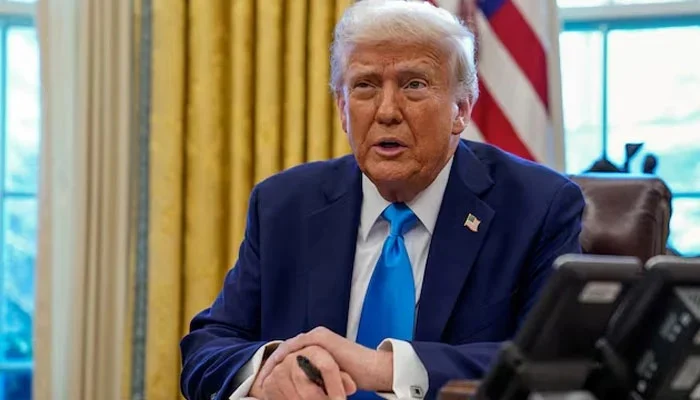
President Donald Trump stated Monday that he will participate “indirectly” in crucial talks between Iran and the U.S. over Tehran’s nuclear program scheduled for Tuesday in Geneva. He expressed his belief that Iran is interested in reaching an agreement. During a flight on Air Force One, Trump told reporters, “I’ll be involved in those talks, indirectly, and they will be very important.”
Current tensions are high ahead of the negotiations, with the U.S. deploying additional military assets to the region, preparing for the possibility of a prolonged military conflict if diplomacy fails, according to U.S. officials speaking to Reuters. Trump reflected on Iran’s negotiating tactics, noting that Iran has historically adopted a tough stance, exemplified by last summer’s U.S. airstrikes on Iranian nuclear sites. Nonetheless, he believes Iran’s motivation to negotiate now is stronger, saying, “I don’t think they want the consequences of not making a deal.”
Before the June strikes, U.S.-Iran negotiations had stalled over Washington’s demand that Iran suspend enrichment activities, which the U.S. regards as a move toward developing nuclear weapons. Trump remarked, “We could have struck a deal instead of sending B-2s to eliminate their nuclear capabilities, but we had to send the bombers.” He added, “I hope they will be more reasonable this time.”
Late last week, Trump took a different tone, suggesting the possibility of regime change in Iran and expressing dissatisfaction with decades of failed diplomacy. Iran’s Foreign Minister Abbas Araqchi met with the UN nuclear watchdog’s chief in Geneva on Monday, stating he aims to secure a “fair and equitable deal.” He emphasized, “Submission to threats is not on the table.”
The IAEA has been urging Iran for months to explain the whereabouts of 440 kg (970 pounds) of highly enriched uranium after Israeli and U.S. strikes, and to allow inspections of key sites bombed last June, including Natanz, Fordow, and Isfahan. Iran has repeatedly threatened to block the Strait of Hormuz in retaliation for any attack, a move that would disrupt roughly 20% of global oil exports and likely cause crude prices to spike.
On Monday, Iran conducted a military exercise in the Strait of Hormuz, a crucial route for international shipping and regional oil exports. Despite Trump’s remarks suggesting Iran might be seeking a deal, negotiations face significant hurdles. The U.S. has pushed to include non-nuclear issues such as missile stockpiles, while Iran insists negotiations should focus solely on its nuclear program in exchange for easing sanctions. Iran refuses to accept zero uranium enrichment and considers its missile program off the table.
U.S. Secretary of State Marco Rubio, visiting Hungary on Monday, acknowledged the difficulty of reaching an agreement but sees an opportunity for diplomacy. “I believe there is a chance to negotiate an agreement, but I don’t want to overstate it,” he said. “It’s going to be tough. Iran is run by radical Shia clerics who make decisions based on theology, not geopolitics.”
 ChatGPT
 Perplexity
 Gemini AI
 Grok AI