Select Language:
Germany and France have called Trump’s tariffs “blackmail.” Greenland emphasizes its status as a democratic society with the right to decide its future, and its prime minister states that the current tariff agreement with the U.S. will be temporarily suspended.
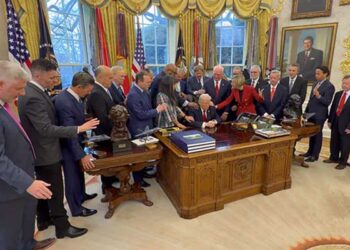
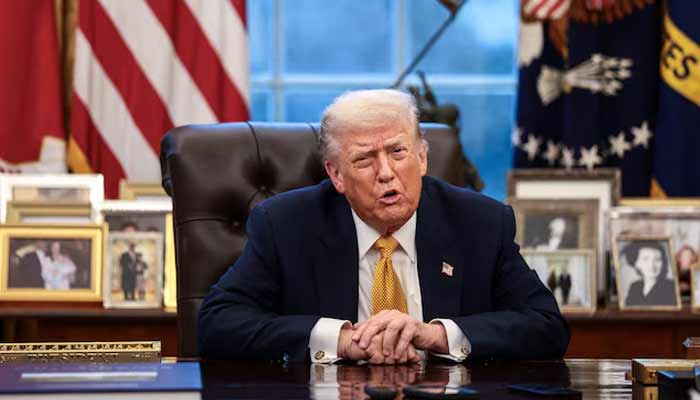
In an exclusive interview at the White House on January 14, 2026, President Donald Trump declared that he no longer needs to prioritize peace after being overlooked for the Nobel Prize. He asserted that global security hinges on U.S. control over Greenland. Trump’s aggressive stance on Greenland has strained the transatlantic alliance, with threats to take the island by force, prompting European nations to unite against his plans for the Danish territory.
European leaders condemned Trump’s threats, labeling them as “blackmail,” and announced preparations for trade retaliation. The European Union plans an emergency summit on Thursday to determine its course of action, expressing a preference to de-escalate but ready to respond if necessary.
Greenland dismisses the tariff threats, reaffirming its commitment to independence. Prime Minister Jens-Frederik Nielsen stated via Facebook that Greenland will not be coerced, emphasizing its sovereignty and democratic nature.
Trump, however, doubled down with a message to Norway’s Prime Minister Jonas Gahr Støre, claiming the world’s safety depends on “complete and total control of Greenland,” and dismissing peace as a primary focus. This message, confirmed to AFP, was in response to opposition from Støre and Finnish President Alexander Stubb, who opposed Trump’s tariffs. Støre clarified that the Nobel Peace Prize is awarded by an independent committee, not the Norwegian government.
Despite existing U.S. military bases and NATO agreements with Denmark, Trump insists Greenland is vital for national security, arguing Denmark cannot defend it from Russia or China. Danish defense officials confirm that NATO allies are increasing military activities in the Arctic and North Atlantic and plan to meet with Greenland’s foreign minister to discuss further steps.
Trump announced that starting February 1, several European countries—including Denmark, Norway, Sweden, France, Germany, the UK, the Netherlands, and Finland—would face a 10% tariff on goods shipped to the U.S., potentially rising further. German Vice Chancellor Lars Klingbeil condemned the move as “blackmail,” and France’s finance minister Roland Lescure agreed that such tactics between longtime allies are unacceptable.
Europe is considering countermeasures, such as suspending the current tariff agreements, reimposing tariffs on U.S. imports, or employing other economic tools. Stock markets dipped as trading began, with UK Prime Minister Keir Starmer warning against a damaging trade war.
Greenland, which has a small population of around 57,000 and has expressed concerns over Trump’s threats, continues to assert its independence. The Greenlandic dogsled federation announced that the new U.S. envoy to Greenland would be disinvited from its annual race, a move viewed as a clear rejection of Trump’s influence.
 ChatGPT
 Perplexity
 Gemini AI
 Grok AI