Select Language:
- Trump states, “We will monitor” the situation in Iran.
- Gulf Arab nations express concern about potential U.S. military actions.
- Trump advisors are evaluating various options, according to sources.
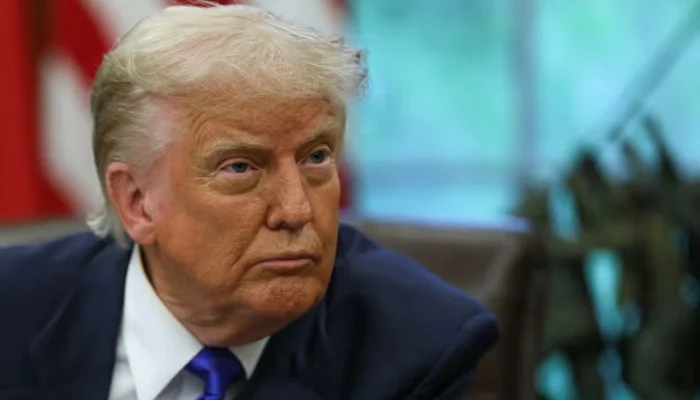
On Wednesday, U.S. President Donald Trump noted that the violence stemming from Iran’s nationwide protests appeared to be decreasing and voiced his belief that there are no plans for large-scale executions of protesters. However, analysts and diplomats have warned of potential dangers linked to possible U.S. military involvement.
His remarks during a gathering in the Oval Office come amid growing worries in the Middle East that the U.S. might carry out strikes on Iran, prompted by Trump’s repeated threats to intervene in support of protesters. He did not completely rule out the possibility of military action but did not confirm plans for such measures either.
Some experts and regional diplomats caution that military intervention could intensify the crackdown by authorities, possibly leading to more violence against those involved and provoking Iranian missile strikes against U.S. military bases in the Middle East.
In a worst-case scenario, several analysts suggest that U.S. strikes could expedite the collapse of the Iranian government, potentially causing chaos in the 90-million-strong country, encouraging insurgencies by minority Kurdish and Baloch groups, and compromising Iran’s nuclear and missile programs.
Nonetheless, recent U.S. intelligence assessments—according to four well-informed sources—indicate that although the protests are a serious challenge, the regime does not seem close to collapse.
“We face unrest among ethnic minorities. There are loosely controlled fissile materials. Missile inventories are scattered with no clear command. Refugee flows have persisted for over a decade… and significant atrocities are ongoing,” explained Behnam Ben Taleblu of the Foundation for the Defense of Democracies. “All fears associated with regime change would be intensified.”
Meanwhile, Iran’s Foreign Minister Abbas Araqchi assured that “there are no plans” to hang protesters amid ongoing protests against the government.
He told Fox News during an interview on “Special Report with Bret Baier,” “Hanging is completely out of the question.”
The protests are considered the most substantial challenge to Iran’s clerical leadership since the 1979 Islamic Revolution, with massive crowds demanding the removal of the current government and clashing with security forces.
One Iranian official reported that over 2,000 people have died since protests began on December 28; a human rights organization estimates the death toll exceeds 2,600. Many analysts believe the actual number is even higher.
The White House and Iran’s UN delegation did not immediately comment.
On Wednesday, Trump cited “very reliable sources” indicating that the violence in Iran is diminishing and expressed belief that large-scale executions are not currently planned.
He left open the possibility of U.S. military action, stating, “We will observe how things develop,” while praising Iran for a “very good statement.”
Concerns Across the Middle East
A regional diplomat, speaking anonymously, said, “Gulf Arab states are really worried,” adding that, in conversations with both the U.S. and Iran, they have been urging calm.
U.S. warnings of possible intervention gained further weight Wednesday as the U.S. began relocating some personnel from the region after an Iranian official claimed neighboring countries were told that American bases could be targeted in retaliation.
Not everyone is alarmed about potential U.S. strikes.
Abdullah Mohtadi, leader of the Kurdish secular democracy advocate group Komala Party of Iranian Kurdistan, dismissed separatist fears, stating only significant U.S. strikes might halt the security forces’ violent crackdown on protesters.
“The chaos is already happening. The priority is to stop the slaughter of people,” said Mohtadi, who resides in London. He believes opposition groups could unite to replace Iran’s theocratic regime with a democratic government.
Trump, who launched strikes against three Iranian nuclear sites in June during a 12-day conflict between Israel and Iran, has not disclosed specific plans.
One source indicated Trump’s aides are considering various options, including limited strikes on symbolic military targets.
Experts suggest that Trump’s repeated threats might have left him little choice but to act if security forces escalate their crackdown, as failing to respond could damage his credibility.
The critical issue, according to Behnam Ben Taleblu, is which targets would be hit.
“The nature of the targets can influence subsequent protests—if strikes are perceived as symbolic, it might dampen unrest, but if they truly impact security forces, they could provoke further protests,” he explained.
Another approach could be to disrupt Iran’s financial streams and launch cyberattacks, providing time for protests to unfold without full military intervention, said Jon Alterman from the Center for Strategic and International Studies.
“Military action might lead everyone to expect immediate results or complain of ineffectiveness,” he noted.
Trump remains committed to maintaining pressure on Iran following June’s strikes on nuclear sites. His overall strategy includes both military actions and aggressive rhetoric, aiming to signal to Iran and other adversaries that he is prepared to use U.S. military power, similar to his previous actions, such as the early January operation that ousted Venezuela’s Maduro.
 ChatGPT
 Perplexity
 Gemini AI
 Grok AI