Select Language:
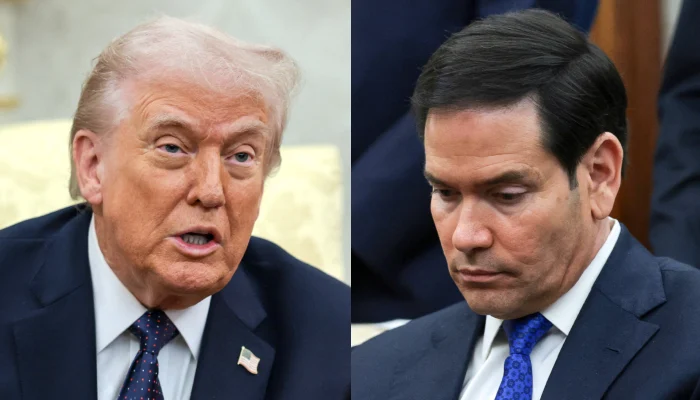
President Donald Trump announced on Tuesday that he ordered U.S. forces to participate in Israel’s attack on Iran because he believed Iran was about to launch a preemptive strike. This statement contradicts his secretary of state’s explanation from the previous day, which cited fears of Iranian retaliation to Israeli actions against Tehran as the reason for U.S. involvement.
Secretary of State Marco Rubio stated on Monday that the U.S. initiated the attack due to concerns that Iran would respond aggressively to Israeli measures aimed at Tehran. Rubio explained, “We knew there was going to be Israeli action, which would likely provoke an attack against American forces, and if we didn’t act preemptively, we would face higher casualties.”
Trump dismissed the idea that Israel influenced the U.S. decision, suggesting instead that he may have compelled Israel to act. In the Oval Office during a meeting with German Chancellor Friedrich Merz, Trump said, “I might have forced their (Israel’s) hand. We were negotiating with these radicals, and in my opinion, they were going to attack first. If we hadn’t acted, they would have attacked first. I strongly felt that.”
Iran has condemned the U.S. invasion, calling it unprovoked. Some prominent conservative voices have intensified their criticism, implying that Israel, not American leadership, is calling the shots. Podcaster Matt Walsh tweeted to his four million followers that Rubio’s comments suggested Israel, rather than the Trump administration, was directing U.S. war efforts, calling it “the worst possible thing.”
Megyn Kelly, a conservative media figure, expressed skepticism about Trump’s decision, asserting that the U.S. government’s primary responsibility is to protect its own citizens, not Israel or Iran. She said, “This seems clearly to be Israel’s war,” prior to Rubio’s remarks.
Amid these conflicting narratives, the White House is engaged in damage control. Trump addressed the press publicly for the first time since the conflict began three days earlier, after previously providing comments through videos, select interviews, and brief remarks on social media.
He claimed that Iran was on the verge of launching an attack, although he provided no evidence, following negotiations with Iran in Geneva last Thursday that Iran described as productive, with additional talks planned. Trump stated, “It was something that had to be done,” though he didn’t offer detailed justification for the military action.
Rubio clarified his earlier position on Capitol Hill, telling reporters, “The bottom line is this: the president determined we wouldn’t be hit first. That’s all there is to it.”
Two senior officials from Trump’s administration held a conference call to outline the events leading up to the strikes. They discussed the Geneva negotiations, where U.S. envoys Steve Witkoff and Jared Kushner pressed Iran to abandon uranium enrichment plans. Iran proposed an alternative plan that would allow higher enrichment at the Tehran Research Reactor, which the officials believed was a delaying tactic and unacceptable for U.S. interests.
Iran denies seeking a nuclear weapon but the envoys relayed that a broader agreement similar to the 2015 deal might have been achievable, though it would take months to negotiate. The next day, Trump directed U.S. forces into action, leading to the military strikes on Saturday.
 ChatGPT
 Perplexity
 Gemini AI
 Grok AI