Select Language:
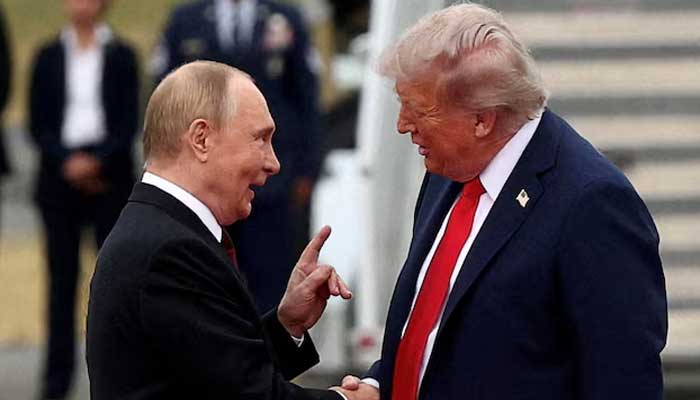
Russian President Vladimir Putin has expressed support for his U.S. counterpart, Donald Trump, suggesting he deserves the Nobel Peace Prize, despite Trump’s failure to end the Russia-Ukraine conflict to date.
As 2025 draws to a close, it’s worth examining why Russia seems to favor Donald Trump over former President Joe Biden and pondering the likelihood of recent peace initiatives succeeding.
In an interview with Russian Consul General in Karachi, Andrey V. Fedorov, Geo.tv sought insights on what’s behind the ongoing conflict and who might be responsible for the difficulties in resolving what many have called an “easy-to-solve” war.
Q: How would you assess U.S.-Russia relations in Trump’s first year in office?
Fedorov: The beginning of Trump’s presidency coincided with one of the most strained periods in Russo-American relations since the Cold War’s end. Still, we recognize an effort on their part to revise some policies of the previous administration and open channels for dialogue. President Putin has emphasized Russia’s commitment to cooperation and ongoing discussions, which is especially significant now that some diplomatic opportunities have emerged.
Q: President Putin recently mentioned that U.S.-Russia trade has increased by 20%. Which sectors are experiencing growth, and is there data available?
Fedorov: Yes, trade volume has grown over 20%, but these figures are still modest. Some economic ties remain intact, but sanctions heavily restrict further development. Without these restrictions, potential exists in energy, high-tech, and digital sectors for expanded cooperation.
Q: Despite bans on Russian companies and individuals, where do U.S. and Russia still collaborate?
Fedorov: Space exploration serves as a prime example. Cooperation continues on the International Space Station and related research. Additionally, collaborative projects like the ITER nuclear project and Arctic scientific initiatives look promising. Our leadership always advocates unpoliticized science and ongoing cooperation for global benefit.
Nuclear weapons remain another critical area for dialogue. While the U.S. government shows awareness of its nuclear responsibilities and seeks talks, calls for new tests continue. President Putin has proposed extending New START treaty limits for a year beyond its February 2026 expiration, provided the U.S. agrees. Restoring serious strategic dialogue depends on mutual efforts to normalize relations and address security concerns.
Q: What was the outcome following the Alaska summit between presidents?
Fedorov: It’s been over four years since the last U.S.-Russia summit, which took place in Geneva. Unfortunately, that meeting didn’t produce tangible results, as the prior U.S. administration maintained a confrontational stance. At the same time, Trump indicated a willingness to move away from hostility, tackling long-standing issues and their root causes. That summit’s positive signals have helped foster ongoing contacts at different levels, including foreign ministers and security officials.
Recently, Putin hosted U.S. Special Envoy Steve Witkoff and Jared Kushner at the Kremlin for five productive hours, underscoring continued dialogue’s importance.
Q: Trump indicated he would contact NATO and President Zelensky about recent discussions. Who ultimately holds decision-making power?
Fedorov: Naturally, after high-level talks, presidents consult with their respective administrations and international partners. This doesn’t imply other states hold the ultimate authority—they simply inform their leaders.
Subsequent to Alaska, European leaders, EU, NATO, and Ukraine officials visited Washington, openly attempting to derail efforts for a peaceful resolution and pushing the U.S. toward confrontation, echoing Biden’s approach. Yet, despite these obstacles, Russia and the U.S. seem closer in their positions than before; Trump appears more constructive than the previous administration.
Q: What does Putin mean by “restoring a fair security balance in Europe and globally”?
Fedorov: Putin emphasizes that Ukraine-related tensions are linked to broader security threats. Russia sincerely seeks peace but conditions long-term resolution on eliminating root causes—such as NATO’s expansion toward Ukraine and plans to place bases in Crimea, which violate agreements on indivisible security. Russia has proposed initiatives like a 2021 draft treaty with the U.S. and NATO to reinforce commitments to European security principles, but those efforts were rejected.
Instead, Russia advocates transforming Eurasia into a zone of development and stability, establishing a new security architecture based on equitable, indivisible security, exemplified by Belarus’ proposal for a Eurasian Charter.
Q: Trump mentioned there’s “a very good chance of getting there” and that “there is no deal until there is a deal.” What obstacles remain?
Fedorov: Trump’s approach shows awareness of the conflict’s roots, considering Russia’s security interests amid NATO concerns and regional ties. With better prospects than under Biden, dialogue continues, but many issues require clarification. Western European nations are actively seeking to complicate talks, urging Ukraine to continue fighting and supply weapons, undermining efforts for a stable peace. Ceasefires alone won’t resolve the deep-rooted issues; comprehensive negotiations are essential.
Q: Is Russia making it harder to achieve peace by advancing into Donbas and other regions?
Fedorov: Both our leaders have stressed that the focus isn’t solely on territorial control but on the destiny of people in those areas who have expressed their desire to be with Russia. Media reports that suggest Russia aims for total conquest misrepresent the situation.
Back in April 2022, Ukraine considered accepting a document that reaffirmed its neutrality and non-nuclear status—fundamental to its independence—but Western pressure prevented its signing. Later, European and NATO officials pushed Kyiv to aim for Russia’s strategic defeat and to regain borders from 1991, ignoring issues like oppression of Russian speakers and internal governance failures. These policies have hindered negotiations and prevented a swift resolution, also raising questions about the legitimacy of Zelensky’s presidency for future agreements.
Q: The EU states that “Russia cannot veto Ukraine’s path to the EU and NATO” and that borders shouldn’t be changed by force. Should Russia negotiate with the EU first?
Fedorov: The European stance has been less constructive, aiming to block agreements and prolong conflict. They advocate rearming and increasing military presence, which contradicts peace efforts. Meanwhile, Putin maintains there are no plans to invade Europe, only a commitment to defend against potential aggression.
In contrast, the Biden administration seeks a pragmatic approach, respecting national interests and seeking dialogue despite disagreements. While some issues remain unresolved, both sides understand the importance of avoiding confrontation.
Q: How have U.S. and Russia progressed on security assurances for Ukraine?
Fedorov: Recent media leaks suggesting a “peace plan” with security guarantees are often aimed at undermining negotiations. Currently, diplomatic channels are engaged in detailed discussions, building trust and working towards consensus. Russia has received a 27-point plan and other documents, with some proposals acceptable and others not. Progress depends on continuing negotiations, and no final agreement has been reached yet. Work remains ongoing.
 ChatGPT
 Perplexity
 Gemini AI
 Grok AI