Select Language:
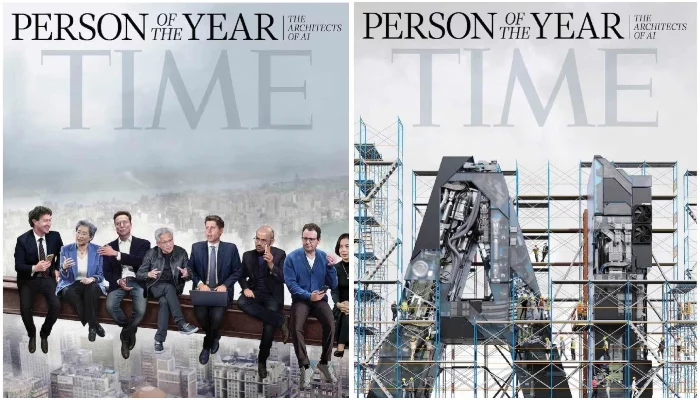
Time magazine has selected the “Architects of AI” as its Person of the Year for 2025, emphasizing the influential role of leading US technology companies developing advanced artificial intelligence. Jensen Huang from Nvidia, Sam Altman of OpenAI, and Elon Musk from xAI are among those recognized for steering history by creating transformative technologies that are reshaping our information systems, environment, and daily lives.
One of the magazine’s covers pays tribute to the iconic 1932 photograph of steelworkers sharing lunch high above New York City. The illustration features tech leaders such as Mark Zuckerberg of Meta, Lisa Su of AMD, Musk, Huang, Altman, Demis Hassabis of Google’s AI division, Dario Amodei of Anthropic, and Stanford professor Fei-Fei Li seated above the city. The caption notes that these innovators have collectively made huge investments, with multibillion-dollar bets on some of the largest infrastructure projects ever, influencing government policies, altering international rivalries, and integrating AI into homes. They have positioned AI as a critical tool in the high-stakes competition among global powers, comparable to nuclear weapons in its significance.
The magazine also credits investors like SoftBank CEO Masayoshi Son, who has poured billions into AI development. The choice of Person of the Year reflects the profound impact of AI over the past year, notably after AI models such as ChatGPT and Claude gained widespread adoption.
Time’s pick is meant to honor the most influential figure of the year. Past recipients have included President-elect Donald Trump, pop star Taylor Swift, and Ukrainian President Volodymyr Zelensky.
According to Time, owned by Silicon Valley billionaire Marc Benioff, 2025 was the year AI moved from promising potential to tangible reality, with ChatGPT usage more than doubling to reach 10% of the global population. Nvidia CEO Jensen Huang described AI as “the most impactful technology of our time,” projecting the technology could expand the global economy from $100 trillion to as much as $500 trillion.
However, the magazine also highlights concerns surrounding AI’s darker implications. Lawsuits allege chatbots have contributed to suicides and mental health issues, raising fears over “chatbot psychosis,” where users may fall into delusions or paranoia. In one case, the parents of 16-year-old Adam Raine are suing OpenAI, alleging ChatGPT provided information about suicide methods that contributed to his death.
The article also discusses potential job disruptions as organizations accelerate replacing workers with AI systems. Despite the focus on AI, the magazine deliberately avoided using AI to generate its cover art, opting instead for human artists.
Thomas Hudson, chief analyst at US research firm Forrester, agrees with the decision, noting that AI’s influence in 2025 has centered on economic shifts and ongoing discussions about societal impacts.
 ChatGPT
 Perplexity
 Gemini AI
 Grok AI