Select Language:
When Israeli and U.S. strikes killed Ayatollah Ali Khamenei at the onset of the Middle East conflict, Iran’s security chief Ali Larijani’s influence surged beyond decades of prior power.
Israeli Defense Minister Israel Katz claimed Tuesday that Larijani had been killed, although Iranian officials have yet to confirm his death.
Since the war’s beginning, Larijani has taken a far more prominent role than Iran’s new Supreme Leader, Mojtaba Khamenei, who has not appeared publicly since succeeding his assassinated father.
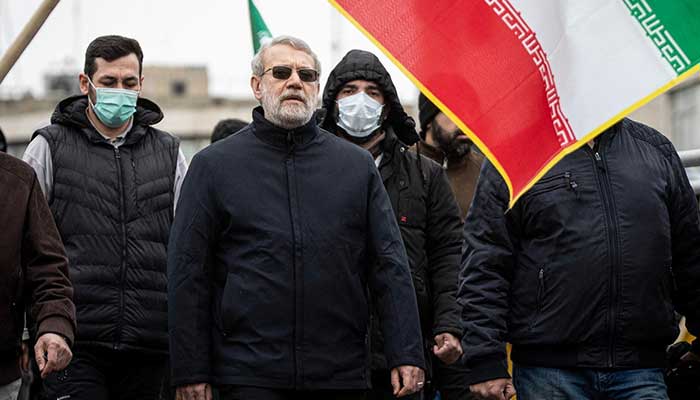
Last week, Larijani was seen walking among crowds at a pro-government rally in Tehran, signaling defiance against Israel and the U.S.
If confirmed dead, his assassination would deal a significant blow to Iran, weakening a figure considered capable of steering both ideological and diplomatic efforts.
### Pragmatic and Strategic
Larijani, known for his calm demeanor and ability to balance ideological loyalty with practical statecraft, was vital to Iran’s nuclear policymaking and strategic diplomacy before the war.
Getting his start in Najaf, Iraq, in 1957, he was born into a prominent cleric family close to Ayatollah Khomeini, Iran’s founding figure. Some relatives have faced accusations of corruption over the years, which they have denied.
He earned a PhD in Western Philosophy from the University of Tehran. A veteran of the Iran-Iraq war, Larijani later led state broadcasting IRIB for ten years from 1994 before serving as Parliament Speaker from 2008 until 2020.
In 1996, he became Khamenei’s envoy to the Supreme National Security Council (SNSC) and later served as its secretary and chief nuclear negotiator, leading talks with Britain, France, Germany, and Russia from 2005 to 2007.
He ran for president in 2005 but was defeated by Mahmoud Ahmadinejad, with whom he later had disagreements over nuclear negotiations. Larijani was disqualified from presidential races in 2021 and 2024.
His return as SNSC head signaled a shift toward a more conservative but pragmatic approach, reflecting his reputation as a seasoned insider. He backed the 2015 nuclear agreement with world powers, which unraveled three years later after the U.S. withdrew under Trump.
In March 2025, Larijani warned that sustained external pressure could push Iran toward nuclear weapons. “We are not pursuing nuclear arms, but if you meddle in Iran’s nuclear program, we may be forced to develop weapons for self-defense,” he stated.
He consistently argued that negotiations with Washington should focus solely on nuclear issues and insisted uranium enrichment is Iran’s sovereign right.
Larijani was among officials sanctioned by the U.S. in January for alleged “violent repression” during mass protests sparked by rising living costs. He acknowledged economic pressures contributed to unrest but blamed foreign interference by the U.S. and Israel for inflaming violence.
 ChatGPT
 Perplexity
 Gemini AI
 Grok AI