Select Language:
President Donald Trump made history as the first sitting U.S. president to attend a Supreme Court argument. The session focused on his administration’s attempt to restrict birthright citizenship for children of certain immigrants, a move that challenges the long-standing interpretation of the 14th Amendment. During the proceedings, justices expressed skepticism about the legality of the order, which directs agencies not to recognize citizenship for babies born in the U.S. if neither parent is an American citizen or legal immigrant.
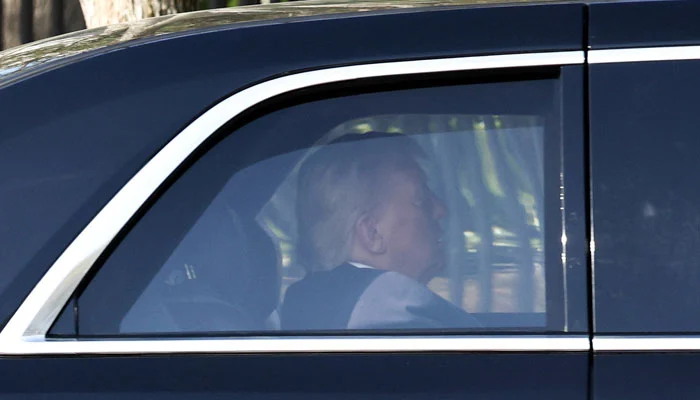
Trump, dressed in a dark suit and red tie, occupied a front-row seat in the courtroom’s gallery. He briefly left the courtroom after the initial part of the argument, which was presented by a Justice Department lawyer supporting his administration’s stance.
The nine justices, including both conservatives and liberals, questioned the legal basis of Trump’s executive order and its potential impact. The court is majority conservative, with six justices. The challenge to the order originated from a lower court ruling that blocked its implementation, asserting it violated the Constitution and federal law that guarantees birthright citizenship.
Historically, the 14th Amendment ensures citizenship for anyone born in the United States, with exceptions like children of foreign diplomats or invading enemies. The administration argues that the phrase “subject to the jurisdiction thereof” limits citizenship to those with complete jurisdiction, excluding children born to undocumented immigrants or people in the country temporarily.
Chief Justice John Roberts pointed out that the legal arguments from the administration appeared “quirky,” suggesting that historically, the clause excluded only children of diplomats and enemy invaders, not broad categories of immigrants. He also questioned the evidence behind claims of widespread “birth tourism,” where foreigners travel to the U.S. to give birth for citizenship purposes.
The current legal dispute ties back to the 1868 ratification of the 14th Amendment, which was designed to overturn prior rulings denying citizenship based on race, and to clarify rights after the Civil War. Its Citizenship Clause states: “All persons born or naturalized in the United States, and subject to the jurisdiction thereof, are citizens of the United States.”
President Trump tweeted after the hearing that the U.S. is “STUPID” for maintaining birthright citizenship, reflecting his opposition. His policy aims to redefine the interpretation of the clause, but critics argue it undermines constitutional protections established for over 150 years.
The justices’ questions highlighted the complex constitutional and legal issues involved, with the court set to decide whether the administration’s interpretation can stand or if the longstanding practice of automatic citizenship at birth remains the law.
 ChatGPT
 Perplexity
 Gemini AI
 Grok AI