
Select Language:
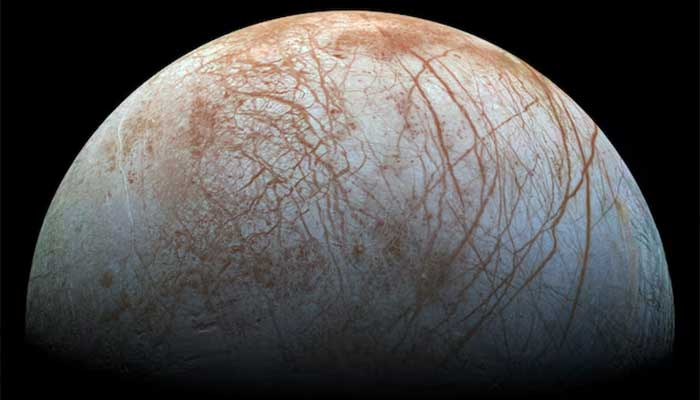
Jupiter’s moon Europa is among the top contenders in our solar system for potential extraterrestrial life, thanks to a subsurface saltwater ocean believed to be hidden beneath an icy crust. However, recent studies are casting doubt on Europa’s habitability prospects.
Researchers examined the likelihood of tectonic and volcanic activity at Europa’s ocean floor—processes on Earth that promote rock-seawater interactions, producing vital nutrients and chemical energy necessary for life. Their models suggest Europa’s rocky seabed might be too resistant to permit such geological activities.
The evaluation took into account Europa’s size, the composition of its core, and the gravitational tug from Jupiter—the largest planet in our solar system. The findings indicate that significant faulting or geological activity at Europa’s seafloor is unlikely, implying the moon may be devoid of life.
“On Earth, tectonic activities like fracturing and faulting expose fresh rock to water, enabling chemical reactions that create compounds such as methane—food for microbes,” explained Paul Byrne, a planetary scientist at Washington University in St. Louis and lead author of the study published in Nature Communications. “Without such processes, sustaining these reactions—and thus supporting life—becomes much more difficult.”
While Earth’s early life thrived around active seafloor hydrothermal vents, Europa might lack similar features. “Based on what we’ve modeled, the seafloor probably doesn’t host major tectonic structures like ridges or deep troughs, nor does it likely have underwater volcanoes or hydrothermal activity akin to black smokers. But I remain open to being corrected,” said Christian Klimczak, a geologist at the University of Georgia and co-author.
Europa spans roughly 1,940 miles (3,100 km) in diameter—slightly smaller than our Moon. Its icy shell is estimated at about 10-15 miles (15-25 km) thick, concealing an ocean possibly 40-100 miles (60-150 km) deep. The moon’s ocean may contain double the water volume found in Earth’s oceans.
Despite these limitations, Europa exhibits key traits that make it a candidate for habitability. “The three essentials for supporting life are liquid water, organic molecules, and energy sources,” Byrne noted. “Europa checks the first box with its ocean. Organic compounds have been detected on its surface, and tidal forces from Jupiter—despite Europa orbiting farther out than Io—generate internal heat, fulfilling the third requirement.”
NASA launched the Europa Clipper spacecraft in 2024 to explore Europa’s environment, aiming to determine if conditions there could support life. Scheduled for multiple close flybys starting in 2031, the mission will gather detailed data.
“Keenly observing Europa remains our best bet in the search for alien life, as each celestial body we study shows unique features,” Klimczak added.
Jupiter’s gravity influences its moons in diverse ways. Io, the innermost large moon, is the most volcanically active body in the solar system due to intense tidal heating caused by Jupiter’s pull and gravitational interactions with other moons. Europa, located farther away, experiences less tidal stress—enough to keep its ocean from freezing solid but unlikely to cause significant tectonic deformation or volcanic activity.
This study focused solely on Europa’s present-day geophysical state, acknowledging that billions of years ago, Europa might have been more geothermally active, possibly offering conditions more conducive to life that later declined.
Ultimately, while Europa’s current environment appears less promising for life than previously thought, ongoing research and upcoming missions keep the hope alive that clues to its past and potential habitability may still be uncovered.
 ChatGPT
 Perplexity
 Gemini AI
 Grok AI