Select Language:
Rare earth elements are minerals vital for creating magnets essential to automotive, electronics, defense, and renewable energy sectors. Last week, the U.S. Treasury Secretary criticized China’s export restrictions on technologies involved in rare-earth mining, smelting, and processing, describing the situation as “China versus the world.” Here are some important facts:
Despite the name, rare earths are not particularly scarce. Comprising 17 heavy metals—including dysprosium, neodymium, and cerium—they are plentiful within the Earth’s crust. As of 2024, the U.S. Geological Survey estimated global deposits at approximately 110 million tonnes. China holds about 44 million tonnes, making it the largest producer. Vietnam has an estimated 22 million tonnes, Brazil around 21 million, Russia 10 million, and India nearly seven million.
Mining these minerals is environmentally challenging, involving heavy chemical usage that generates toxic waste and has led to environmental disasters. The high costs associated with extraction and processing, coupled with the minerals’ typically low ore concentrations, mean vast quantities of rock must be processed to yield refined material, often in powdered form.
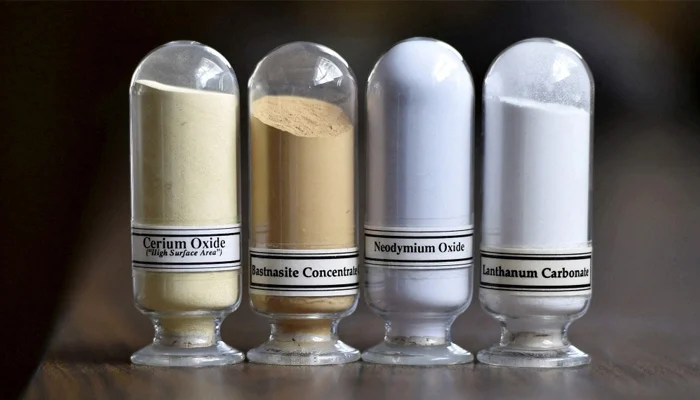
These 17 rare earths are embedded in many common and high-tech products, from light bulbs to guided missiles. Europium enhances television screens, cerium is used for glass polishing and oil refining, and lanthanum helps catalytic converters work efficiently. Each possesses unique, mostly irreplaceable properties; for example, neodymium and dysprosium are key for making nearly permanent, powerful magnets used in offshore wind turbines and other technologies.
China has dominated the rare earth market by investing heavily in refining infrastructure, often with lax environmental oversight. The country has secured numerous patents related to rare earth production, creating barriers for competitors globally. Consequently, many companies prefer to send their ore to China for processing, perpetuating reliance on Beijing. In April, China mandated domestic exporters to obtain licenses—seen as a response to U.S. tariffs—raising concerns in Washington over potential supply shortages. Although a deal was announced in June to prioritize supplying these critical materials, supply chains remain uncertain due to bureaucratic delays and restrictions.
The U.S. and European Union predominantly rely on China for their rare earth supplies but are actively working to develop local production and recycling efforts to reduce dependence. The 2019 U.S.-China trade tensions highlighted potential risks, with fears that China might curb exports as retaliation. Japan experienced a similar scenario in 2010 when China temporarily halted rare earth exports amid a territorial dispute, prompting Japan to diversify its sources by partnering with Australia’s Lynas in Malaysia and expanding recycling capabilities.
 ChatGPT
 Perplexity
 Gemini AI
 Grok AI