Select Language:
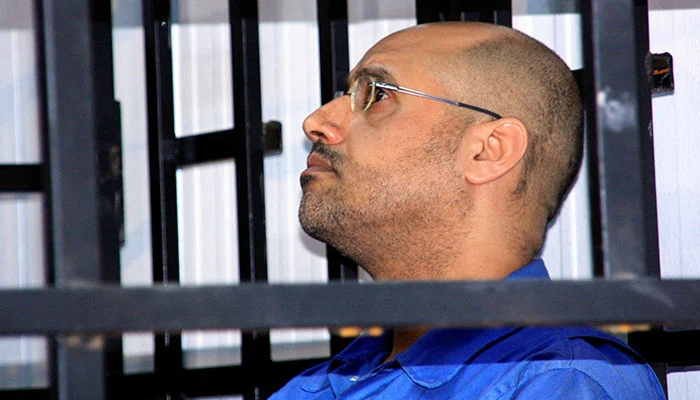
Libya’s Saif al-Islam Gaddafi, son of the late leader Muammar Gaddafi, was seen attending a court hearing behind bars in Zintan on May 25, 2014. — Reuters
Sources close to his family, along with his lawyer Khaled el-Zaydi and local media, reported that Saif al-Islam has been killed. The exact details surrounding his death remain unclear at this time.
Once regarded as the most influential figure in Libya despite lacking an official government role, Saif al-Islam rose to prominence as the heir apparent to his autocratic father, Muammar Gaddafi, who ruled Libya for over forty years. He played a key role in shaping national policy, mediating delicate diplomatic negotiations, and leading talks on Libya’s disarmament and compensation for the victims of the 1988 Lockerbie bombing in Scotland.
Eager to improve Libya’s international image, Saif promoted reforms, championed the drafting of a new constitution, and advocated for human rights and respect for the rule of law. Educated at the London School of Economics and fluent in English, he was often seen as the more Western-friendly face of Libya, gaining favor among some governments.
However, during the 2011 uprising that ousted Gaddafi, Saif chose loyalty to his family and tribal roots over his previous alliances. He became a leading figure in a brutal crackdown on rebels—whom he labeled “rats”—warning of a bloodbath and asserting that Libya would require decades to recover. In an interview with Reuters during this period, he declared, “We fight here in Libya, we die here in Libya,” and warned of destruction if the conflict continued.
Following the fall of Tripoli, Saif attempted to escape disguised as a Bedouin on a desert road. He was captured by the Abu Bakr Sadik Brigade militia and taken to Zintan about a month after his father was killed by rebels. In an audio recording, he stated, “I’m staying here. They’ll shoot me the moment I step outside,” expressing his belief that escape was futile.
His years of captivity in Zintan starkly contrasted with his previous privileged lifestyle under Gaddafi, which included pet tigers and hunting trips with falcons, as well as social visits to London. Rights groups noted he was held mostly in solitary confinement, missing a tooth, and had little contact with the outside world, though he had access to television and some books.
In 2015, a Libyan court sentenced Saif al-Islam to death by firing squad for war crimes. He is also wanted by the International Criminal Court at The Hague on charges of murder and persecution, with an arrest warrant issued against him.
After being released in 2017 under an amnesty law, Saif kept a low profile in Zintan to avoid assassination attempts. From 2016 onward, he maintained communication with supporters inside and outside Libya, engaging in political discussions and receiving visitors regularly. He even appeared in Sabha in 2021 to formally announce his candidacy for the presidential election, hoping to capitalize on nostalgia for Libya’s pre-2011 stability.
His bid was controversial and faced opposition from factions that suffered under his father’s regime, including armed groups that reject his candidacy outright. As the election process stalled late in 2021, disputes over his participation contributed to the political impasse. His disqualification after a 2015 conviction, and subsequent attempts to appeal the ruling, were thwarted by armed resistance, leading to the collapse of the electoral efforts and a return to political deadlock.
In a 2021 interview with The New York Times Magazine, Saif described his political approach as gradual and manipulative, saying, “You need to come back slowly, slowly. Like a striptease. You need to play with their minds a little.”
 ChatGPT
 Perplexity
 Gemini AI
 Grok AI