Select Language:
Somalia has declared that it reserves the right to pursue diplomatic and legal actions. The president of Somaliland commended Israel’s “brave” decision. Meanwhile, an Israeli minister stated that recognizing Somaliland was “the morally right move.”
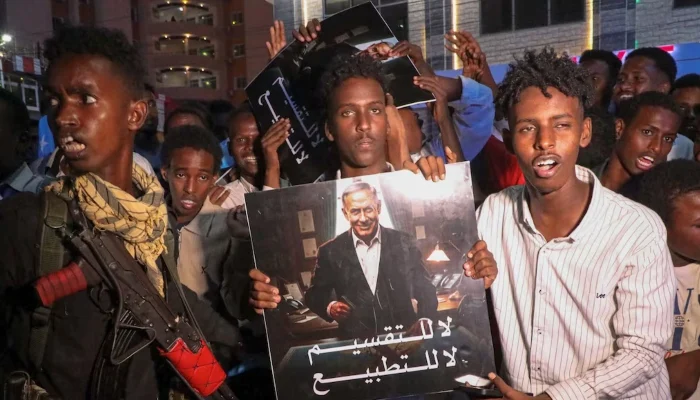
The Israeli foreign minister recently visited the Somaliland region of Somalia, a move Somalia condemned as an “unauthorized invasion.” Israel announced last month that it was officially recognizing Somaliland, a historic step for this self-declared republic since its 1991 declaration of independence from Somalia.
Despite having its own currency, passport, and military, Somaliland struggles to gain international recognition and fears that such recognition could provoke Somalia or encourage other separatist efforts across Africa. Israeli Foreign Minister Gideon Saar, welcomed by senior Somali officials at the airport, said the recognition aligned with Israel’s moral principles. Somaliland’s leader, Abdirahman Abdullahi Mohamed, praised Israel’s “brave” stance and expressed that this could lead to new economic and developmental opportunities. “It advances our strategic partnership,” he stated during a joint press briefing.
Somalia responded with strong anger, calling the visit an “illegal” and “unauthorized invasion.” Somalia’s foreign ministry issued a statement affirming that they reserve the right to take appropriate diplomatic and legal steps to protect their sovereignty, unity, and territorial integrity. The African Union’s Peace and Security Council also condemned Israel’s recognition, demanding its immediate revocation in the strongest terms.
The Arab League echoed concerns, condemning any official dealings with Somaliland as a clear violation of Somalia’s sovereignty. The League emphasized that such moves threaten regional peace and security, adding tension to Somalia, the Red Sea, the Gulf of Aden, and the Horn of Africa.
In response to Israel’s decision, the militant group Al-Shabaab, which has fought the Somali government for nearly 20 years, declared it would oppose any attempt by Israel to establish Somaliland as a base.
Experts suggest the recognition could give Israel improved access to the Red Sea, potentially facilitating operations against Houthi rebels in Yemen. Somaliland’s strategic position next to one of the world’s busiest shipping lanes makes it an attractive partner for various countries.
While the United States voiced support for Israel’s recognition, several nations, including Egypt, Turkey, members of the Gulf Cooperation Council, and the Organization of Islamic Cooperation based in Saudi Arabia, criticized the move. The European Union called for respect for Somalia’s sovereignty.
Somali President Hassan Sheikh Mohamud labeled Israel’s decision a threat to the stability of the already unstable Horn of Africa. He claimed that Somaliland accepted three conditions from Israel: the resettlement of Palestinians, the establishment of a military base on the Gulf of Aden, and joining the Abraham Accords to normalize relations with Israel. Somaliland’s foreign ministry denied that the first two conditions had been agreed upon.
Historically, Somaliland briefly achieved independence in June 1960 upon seceding from Britain but voluntarily united with Italian-controlled Somalia days later. Its leaders argue that the union was never properly ratified and became null when Somalia’s government collapsed in 1991. Since then, Somaliland has maintained a level of stability distinct from the rest of Somalia, despite lacking formal international recognition.
 ChatGPT
 Perplexity
 Gemini AI
 Grok AI