Select Language:
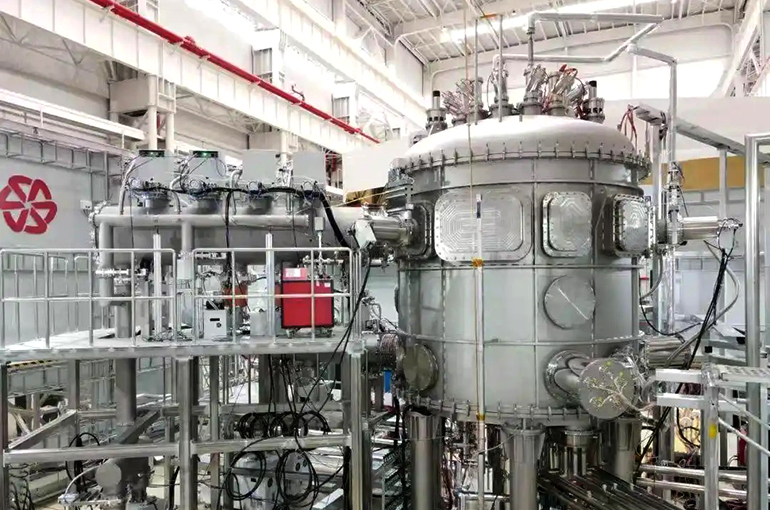
The world’s first fully high-temperature superconducting tokamak operated in Shanghai by a local nuclear energy startup has set a new record for the longest test duration of a commercial fusion device. Recently, it successfully maintained steady, long-pulse plasma operation for over 1,300 seconds, according to company representatives at a media event.
Located in the Lingang Special Area of the China Shanghai Pilot Free Trade Zone, this device is the first of its kind globally to feature a core magnet system entirely made of high-temperature superconducting (HTS) materials. Unlike traditional tokamaks, this model’s HTS magnets significantly enhance plasma confinement performance and reduce both size and construction costs, explained the company’s CEO.
This milestone demonstrates that the company has become the first commercial entity to achieve sustained plasma operation exceeding 1,000 seconds. It also confirms the engineering viability of HTS technology, laying vital groundwork for future commercial nuclear fusion applications, the CEO added.
Looking ahead, the company aims to extend operation times further and obtain more detailed temperature data during future experiments, both key goals for the second half of the year.
Supporters of the industry in the area affirmed that nuclear fusion remains a crucial frontier for future industrial development. Efforts will continue to attract fusion technology companies with various approaches and to build an industrial cluster by inviting upstream and downstream firms, including those producing raw materials like superconducting and wall materials and power systems.
Founded in 2021, this startup pioneered fusion energy development in China and focuses on advancing HTS tokamak devices to speed up fusion energy commercialization. The device completed and activated in June 2024 has already conducted more than 5,700 experiments.
In February, the company raised a Series A financing round from investors including Green Energy and a Low Carbon Industry Investment Fund, though specific amounts were not disclosed. Earlier, it secured nearly 400 million yuan (around USD 58 million) in both a 2022 angel round and a 2023 pre-Series A, with investors such as miHoYo, Nio Capital, HongShan Seed Fund, and Lanchi Ventures.
 ChatGPT
 Perplexity
 Gemini AI
 Grok AI