Select Language:
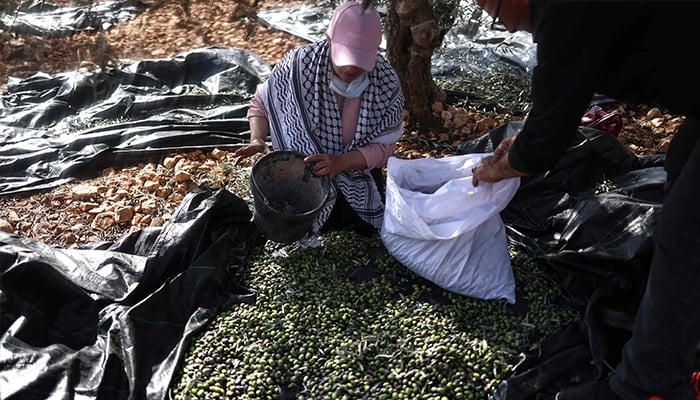
Volunteers assist Palestinian farmers in harvesting olives in Birzeit, north of Ramallah in the Israeli-occupied West Bank, on October 23, 2025. — AFP
The scene was shocking and emphasized the violence surrounding this year’s olive harvest in the West Bank: a masked young man hits an elderly Palestinian woman picking olives, causing her to fall to the ground.
The incident occurred during an attack by Israeli settlers, captured by an American journalist, in the town of Turmus Ayya near Ramallah — a hotspot of violence this year.
“Everyone was fleeing because the settlers attacked suddenly, possibly around 100 of them,” witness Yasser Alkam told AFP, adding that a Swedish activist was also injured with broken arms and legs by settlers.
Alkam, a local official in Turmus Ayya, explained that the woman, 55-year-old Um Saleh Abu Aliya, was struck while waiting for her son to take her away from the mob of settlers.
“Retaliation would only escalate the violence, sometimes supported by the military,” lamented Nael al-Qouq, a farmer from Turmus Ayya, who was prevented from reaching his olive trees that same day.
Expanded settlements
Near the scene, an Israeli flag fluttered on a settlement outpost that is illegal under Israeli law.
The military eventually arrived in Turmus Ayya and dispersed the crowd with tear gas, an AFP journalist observed.
But prior to that, some youths who descended on the village set fire to at least two vehicles.
The head of West Bank Israeli police, Moshe Pinchi, reportedly instructed district commanders to find the man who attacked Abu Aliya, according to a leaked WhatsApp message shared by Israeli media.
Israel’s military told AFP that it “collves in coordination with the Israel Police to enforce law concerning Israelis involved in such incidents.”
However, Turmus Ayya is not an isolated incident. AFP journalists have documented at least six cases where Palestinians were denied access to their land, attacked by settlers, or vandalized during this year’s olive harvest.
Clashes in rural areas have intensified this year, driven by the ongoing expansion of Israeli settlements and an increasing number of settlers — not all of whom participate directly in violence against Palestinians.
More than 500,000 Israelis reside in settlements in the West Bank, occupied by Israel since 1967.
All these settlements are considered illegal under international law.
Uprooted
Near Turmus Ayya, in Al-Mughayyir village, one farmer was completely barred from harvesting.
“I own ten dunams (about one hectare) of olive trees. All that’s left are the trees in my yard… they uprooted everything,” said Abdul Latif Abu Aliya, 55.
His land borders a road, beyond which three trailers form a recently established settlement outpost.
After a settler was injured in an altercation near Abu Aliya’s home, the military ordered the trees his ancestors planted to be uprooted.
Bulldozers pushed soil and roots halfway up the hillside, about 100 meters from his family’s house, creating a barrier that Abu Aliya and his family avoid crossing for fear of settler attacks.
Palestinian farmers argue with security forces after their harvest was disrupted and halted by Israeli settlers in Sa’ir village, near Hebron, on October 23, 2025. — AFP
Amid unprecedented violence during this year’s olive harvest, the Palestinian Authority’s agriculture minister called on the international community to help protect farmers and harvesters.
“This is the worst season in the past 60 years,” said Agriculture Minister Rizq Salimia, noting that the harvest was already challenged by poor weather conditions.
Ajith Sunghay, head of the UN Human Rights Office in Palestinian territories, condemned the “severe attacks” affecting this year’s harvest and highlighted the “dangerous levels of impunity” for those responsible.
Once a peaceful tradition bringing Palestinian families together, the olive harvest in recent years has turned into increasingly violent confrontations involving settlers, soldiers, Palestinian workers, and foreign activists.
As the harvest season begins in October and runs through mid-November, Palestinians across the West Bank harvest olives deeply tied to their national identity.
According to the 2021 census by the agriculture ministry, the West Bank has over eight million olive trees for a population of three million Palestinians.
Every autumn, farmers and city residents with a few trees venture into the fields to pick olives primarily by hand.
The UN’s humanitarian agency, OCHA, reported that during the week of October 7 to 13 alone, 27 villages experienced attacks related to the harvest.
“These included assaults on harvesters, theft of crops and equipment, and vandalism of olive trees,” OCHA stated, resulting in injuries and property damage.
 ChatGPT
 Perplexity
 Gemini AI
 Grok AI