Select Language:
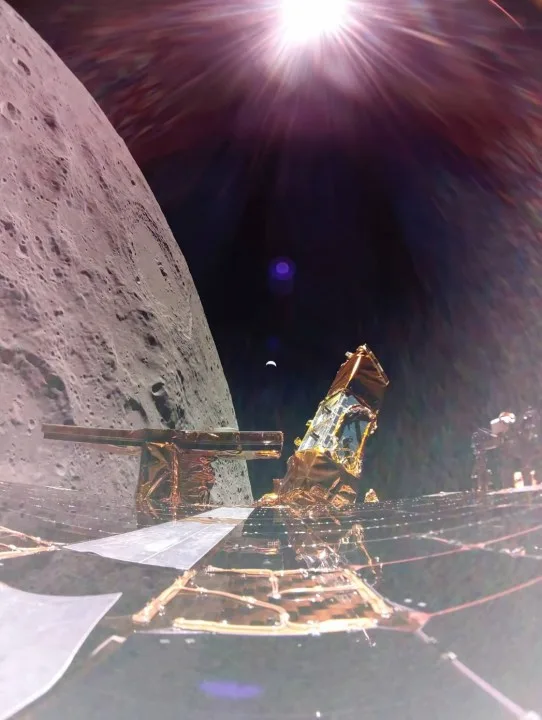
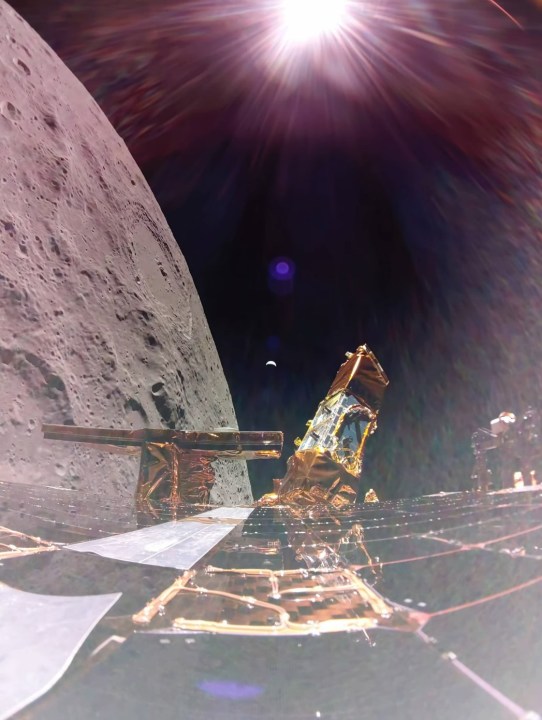
The Blue Ghost mission by Firefly Aerospace is gearing up for its groundbreaking lunar landing endeavor this week. While circling the moon, the spacecraft continues to take breathtaking images of both the Earth and its distant satellite. Recently released footage captures the Earth setting and rising behind the moon shortly after the craft completed its second lunar orbital maneuver.
The footage reveals the moon rising in the background of the Blue Ghost spacecraft, with Earth appearing as a tiny crescent. As the spacecraft orbits the moon, Earth disappears behind it, only to reappear as the craft continues its journey. This striking imagery serves as a poignant reminder that, although the moon is relatively close to us in the vastness of space, Earth appears merely as a small dot in the distance.
According to Firefly Aerospace, “The footage displaying Earth’s rise and set behind the Moon was captured by Firefly’s Blue Ghost lunar lander shortly after our second lunar orbit maneuver on February 18. The video also shows our solar panel, X-band antenna (on the left), and LEXI payload (on the right) positioned on the top deck.”
Along with this captivating footage, Firefly has confirmed that Blue Ghost has successfully completed its third and final lunar orbit maneuver. During this maneuver, the spacecraft’s engines fired for 16 seconds to adjust its orbit, allowing it to move into a near-circular low lunar orbit.
Looking forward, the significant challenge lies ahead as Blue Ghost is set to attempt a soft landing on the moon this Sunday, March 2. If successful, this would mark just the second instance of a commercial craft successfully landing on the lunar surface. To prepare for the landing, the spacecraft will perform another engine burn as it approaches the moon, a maneuver known as Descent Orbital Insertion. The targeted landing site is a region known as Mare Crisium, a lunar basin situated in the northeast area of the moon’s near side.
The spacecraft is carrying various experiments and technological tests for lunar applications, including several payloads from NASA designed to evaluate concepts in anticipation of human missions to the moon as part of the Artemis program. In a recent announcement, NASA revealed that one of these experiments, the Lunar GNSS Receiver Experiment (LuGRE), succeeded in receiving a Global Navigation Satellite System (GNSS) signal from an astounding distance of 246,000 miles, setting a new record for this technology.
 ChatGPT
 Perplexity
 Gemini AI
 Grok AI