
Select Language:
A group of scientists announced on Tuesday that they’ve created specialized deep-sea landers to investigate their controversial finding that metallic rocks on the ocean floor are generating “dark oxygen.”
If an unknown source of oxygen has always been present deep within Earth, this discovery could be groundbreaking, challenging long-standing theories about the origins of life on our planet.
However, the deep-sea mining industry—interested in extracting valuable metals from these small polymetallic nodules—and some scientists remain skeptical of the claim.
To verify their previous findings, British marine ecologist Andrew Sweetman, who headed the 2024 study suggesting the presence of dark oxygen, is planning another underwater expedition in the coming months.
At a Tuesday press briefing, Sweetman and his team introduced two new landers capable of plunging to depths of 11 kilometers (around 7 miles). Their goal is to explore how these nodules might be producing oxygen.
Unlike earlier missions, these landers will employ sensors specifically designed to “measure seafloor respiration,” Sweetman explained.
Built to withstand pressures 1,200 times that of Earth’s surface, these devices resemble equipment used in space exploration, according to a statement.
The landers will be deployed from a research vessel in the Clarion-Clipperton Zone, a large area between Hawaii and Mexico.
Mining companies have plans to begin harvesting these nodules, which contain metals crucial for electric vehicle batteries and other technologies.
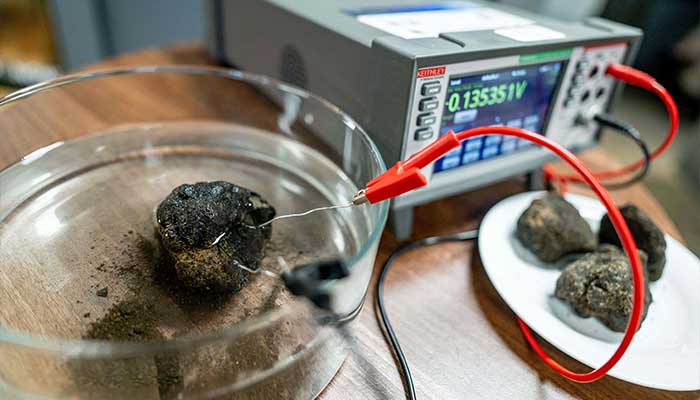
Scientists believe the nodules might produce enough electric charge to split seawater into hydrogen and oxygen through a process called electrolysis.
Sweetman took the opportunity during the briefing to defend his 2024 study against critics.
Some researchers argued that the observed oxygen was not produced by the nodules but was simply trapped air bubbles.
“With over 20 years of experience deploying these instruments, we’ve never encountered bubbles,” Sweetman stated. He added that his team conducted tests to rule out this possibility.
This debate unfolds amid ongoing disputes over proposed regulations for the emerging and potentially environmentally damaging deep-sea mining industry.
Sweetman’s 2024 research was partly financed by The Metals Company, a Canadian firm interested in deep-sea mining, which has since criticized his work sharply.
“If commercial mining proceeds, it could have widespread ecological impacts,” Sweetman warned, noting that the nodules are habitats for a diverse array of marine life.
Nevertheless, he clarified that it is not his goal to halt deep-sea mining but rather to collect comprehensive data to minimize environmental impacts should it move forward.
Germany’s GEOMAR Helmholtz Centre for Ocean Research biogeochemist Matthias Haeckel told AFP that his own research did not support evidence of oxygen production from the nodules.
Haeckel mentioned that Sweetman will join their upcoming cruise at the end of the year to compare methodologies.
The upcoming study, funded by Japan’s Nippon Foundation, will involve Sweetman and his team working aboard a research vessel in the Clarion-Clipperton Zone this May.
“We expect to confirm dark oxygen production within 24 to 48 hours after retrieving the landers,” Sweetman said.
Final results likely won’t be known until the ship returns in June, and additional land-based experiments could take several months, he added.
 ChatGPT
 Perplexity
 Gemini AI
 Grok AI