
Select Language:
Scientists advancing the field of extraterrestrial agriculture have successfully grown chickpeas in soil primarily made from simulated lunar regolith—a significant step toward enabling astronauts on long-duration moon missions to produce their own food.
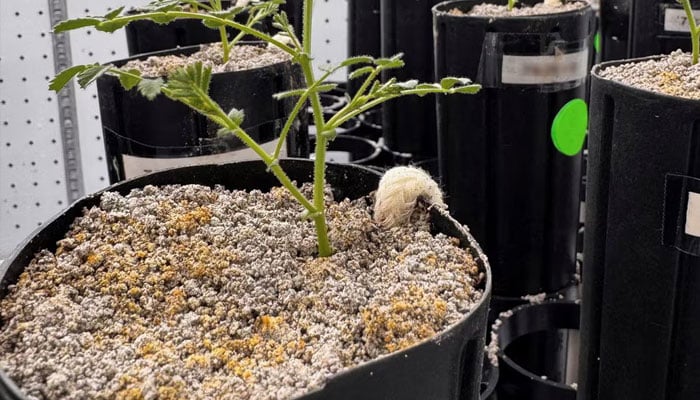
The chickpeas, specifically a variety called “Myles,” were cultivated within a climate-controlled chamber at Texas A&M University. The seeds, coated with beneficial fungi, were planted in a mixture of lunar simulant—created by Florida-based company Space Resource Technologies—and vermicompost derived from organic waste decomposed by earthworms. The soil mixture contained up to 75% simulated lunar soil, known as regolith. As the proportion of lunar soil increased, the number of harvestable chickpeas decreased, though their size remained consistent. Seeds grown entirely in simulated lunar soil did not produce flowers or seeds and died prematurely.
With plans from the U.S. and China to return astronauts to the moon, including establishing sustainable bases, this research underscores the importance of developing lunar farming techniques. Local food sources are critical because transporting food from Earth is logistically and financially challenging, especially considering that weight is a major factor in space missions and supply deliveries are not always timely.
“Chickpeas are rich in protein and other essential nutrients, making them ideal candidates for space cultivation,” explained Jessica Atkin, a NASA fellow and doctoral candidate at Texas A&M’s Department of Soil and Crop Sciences, and the lead author of the study published in Scientific Reports.
Additionally, growing food on the moon could serve other vital functions, such as generating oxygen and supporting life-support systems for future habitats. The moon’s soil, essentially crushed rock and dust formed over billions of years by meteorite impacts, contains nutrients like minerals but is inorganic and inhospitable compared to Earth’s organic-rich soil.
Previous experiments have demonstrated that plants can germinate in authentic lunar samples or regolith simulants, often with added compost or organic matter. This study focused on microbial partnerships, testing whether symbiotic microbes could improve regolith’s structure, plant growth conditions, and reduce stress in the absence of organic material.
In terms of flavor, it remains to be seen. The chickpeas are currently undergoing testing for metal accumulation because lunar and simulant soils contain high levels of metals such as aluminum and iron. Iron is essential for plant growth, but aluminum can be toxic if ingested. Results on their safety and nutritional profile are expected later this year.
The beneficial fungi coating the seeds worked together with the chickpeas, helping the plants absorb nutrients and limiting heavy metal uptake. They even colonized roots in 100% lunar simulant, aiding in particle binding and making the soil function more like Earth’s.
Researchers had some fun in the lab, with Atkin playing lunar-themed songs, including Creedence Clearwater Revival’s “Bad Moon Rising,” to inspire the plants, and posting images of moon-grown chickpeas as motivation.
“This marks an initial move toward lunar crop cultivation,” Oliveira Santos noted. “While it’s a small step, it shows practicality, and we’re moving in the right direction.”
 ChatGPT
 Perplexity
 Gemini AI
 Grok AI