Select Language:
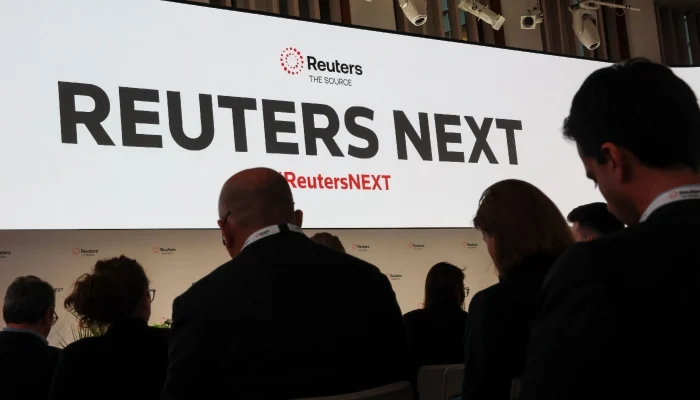
People sit in the audience during the Reuters NEXT conference in New York City on December 4, 2025. — Reuters
The impact of artificial intelligence was the main focus at the Reuters NEXT conference in New York, with panelists emphasizing how AI might reshape the workforce—and possibly lead to job growth—without much concern about an AI bubble.
AI stands as the most significant technological upheaval to the global economy since the internet’s rise 25 years ago. While it has attracted trillions of dollars in investments and driven impressive stock market rallies, it’s also causing shortages in memory chips, increased regulatory oversight, and growing worries about job displacement.
The figures are striking. In the first half of 2025, AI-related spending contributed more to GDP growth than consumer spending, according to JP Morgan Asset Management. Bespoke Investment Group estimates that roughly one-third of the global market cap increase since ChatGPT’s debut stems from 28 AI-related companies.
At Reuters NEXT, most corporate leaders concentrated on how AI will transform workplaces, though some acknowledged concerns about employment risks. “All of our clients are focusing on slowing headcount growth,” said May Habib, CEO and co-founder of AI startup Writer. “This has only become evident in recent weeks. You close a deal, talk to the CEO, and suddenly it’s, ‘How soon can I cut 30% of my team?’”
Fears of job upheaval
An August Reuters/Ipsos poll found that 71% of people worry AI will permanently eliminate too many jobs. A recent U.S. Federal Reserve report highlighted data showing AI is already replacing entry-level roles and prompting companies to cut back on hiring plans.
Economist Joseph Lavorgna, an advisor to the U.S. Treasury Secretary, offered a more optimistic perspective, emphasizing AI’s potential to enhance the workforce rather than diminish it. “AI is an incredible tool that complements current employees,” he said. “We need policies that encourage business investment, and AI can be part of that strategy.”
Despite this optimism, recent employment data paints a complex picture. Unemployment rates for recent college grads between 20 and 24 stand at 9.5%—more than double the overall national rate of 4.4%, according to the Labor Department.
Joe Depa, EY’s chief innovation officer, compared current changes to those seen during earlier tech revolutions like the internet. However, he noted that “disruption is happening faster this time.” Depa emphasized that “adaptability is now the key to job security,” with middle management feeling the brunt of these shifts.
Tracey Franklin, Moderna’s chief people officer and head of digital technology, said companies are reevaluating hiring strategies to align with technological needs, rather than considering them separately.
“We’re combining teams and analyzing their IT infrastructure and human capital strategies together to meet business goals,” she explained. “This integrated approach is something we didn’t do before.”
Skepticism and concerns
The Reuters/Ipsos survey also revealed that 61% are worried about increased power consumption from data centers, which is expected to keep rising. Jeff Schultz of Cisco Systems pointed out that the infrastructure needed to support AI, including high-powered chips and network traffic, already consumes significant energy. The demand from AI systems surpasses that of typical chatbots, making data centers energy hogs.
Opposition to these energy-intensive data clusters is growing, especially in places like Virginia and Pennsylvania, even among supporters of President Donald Trump—who has promoted AI development and is contemplating ways to limit state regulations.
Media and creative industry leaders expressed particular concern about AI-generated content replacing writers, actors, and other creatives. “There’s a lot of debate about protecting the talents in acting and music,” said veteran media executive Shari Redstone. “We must take strong steps to safeguard creative professionals from being replaced.”
Sarah Jessica Parker, star of “Sex and the City,” highlighted the importance of human nuance in entertainment. “People still value the human experience—its unpredictability and spontaneity,” she told Reuters’ Chancellor Galloni. “Even in film, despite the ability to edit and enhance digitally, the human element remains irreplaceable—it’s part of what makes movies memorable, and I don’t believe AI can replicate that raw energy.”
 ChatGPT
 Perplexity
 Gemini AI
 Grok AI