Select Language:
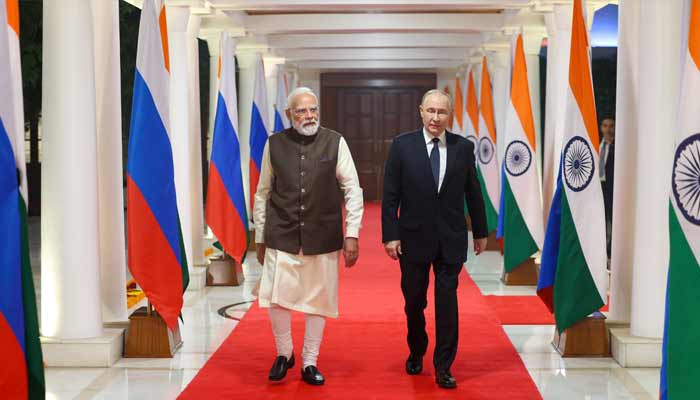
Russian President Vladimir Putin and Indian Prime Minister Narendra Modi agreed on Friday to expand and diversify trade beyond oil and defense, despite Western pressure on New Delhi to reduce its longstanding close ties with Moscow.
India, the world’s largest importer of Russian arms and seaborne oil, warmly welcomed Putin during his two-day official visit—the first since Russia’s invasion of Ukraine in 2022.
The visit coincided with India’s negotiations with the U.S. on a trade agreement aimed at reducing punitive tariffs imposed by former President Donald Trump on Indian goods, especially related to purchases of Russian oil.
Russia expressed its intention to import more Indian products to boost bilateral trade to $100 billion by 2030. Historically, trade has been heavily skewed in favor of Russia due to India’s energy imports.
Modi described India’s relationship with Russia as “a guiding star,” emphasizing that “these ties have always stood the test of time, rooted in mutual respect and deep trust.” He added, “We have agreed on an economic cooperation plan through 2030, designed to make our trade and investment more diversified, balanced, and sustainable.”
Modi, who greeted Putin with a warm hug upon his arrival, reiterated India’s commitment to a peaceful resolution to Ukraine’s conflict.
Putin assured that Russia would continue providing “uninterrupted fuel supplies” to India, signaling resilience against U.S. sanctions. He also highlighted ongoing work on India’s largest nuclear power plant at Kudankulam.
A joint statement following the summit stressed that, despite a complex and uncertain global situation, the Russia-India relationship remains strong and resilient to external pressures.
Putin was received with a ceremonial 21-gun salute at Rashtrapati Bhavan on Friday, marking his official welcome. A substantial delegation from both sides was present, and several agreements were signed, including facilitating Indian workers to move to Russia, establishing a joint fertilizer plant, and enhancing cooperation in agriculture, healthcare, and shipping.
The two nations also agreed to revamp their defense partnership to include joint R&D and the production of advanced military equipment. This strategic shift aims to involve joint manufacturing of spare parts, components, and assemblies for Russian military hardware in India.
In an interview broadcast late Thursday, Putin challenged U.S. efforts to pressure India into not purchasing Russian fuel, asking, “If the U.S. has the right to buy our nuclear fuel, why shouldn’t India have the same right?” He indicated plans to discuss this issue with Trump.
Trade in energy remains steady, despite a slight decrease in the first three quarters of 2025. India has criticized Trump’s tariffs as unjustified, noting continued U.S. imports of Russian energy goods, including LNG and uranium, despite sanctions.
Since European countries sought to reduce their dependence on Russian energy over the Ukraine crisis, India increased its Russian crude oil imports at discounted rates but diminished them under U.S. pressure this year.
Analyst Michael Kugelman from the Atlantic Council pointed out that India faces a tough dilemma: by strengthening ties with Moscow or Washington, it risks alienating the other.
 ChatGPT
 Perplexity
 Gemini AI
 Grok AI