Select Language:
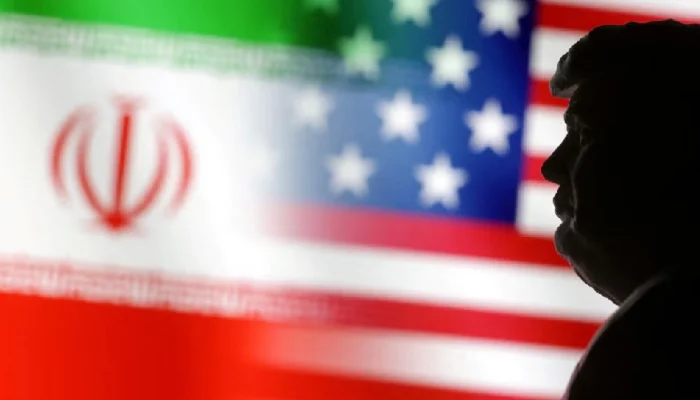
A miniature 3D-printed model of Donald Trump alongside the flags of the United States and Iran is depicted in this illustration dated January 15, 2025. The image is credited to Reuters.
– The U.S. Navy’s increased presence near Iran is heightening tensions in the region.
– Iranian leadership in Tehran is pushing for sanctions to be lifted.
– Iran indicates it is willing to show flexibility regarding uranium enrichment levels.
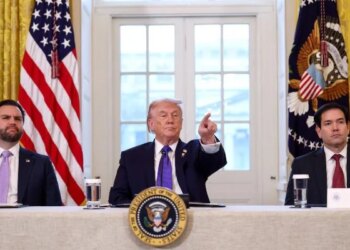
U.S. President Donald Trump announced on Friday that officials had engaged in “very good talks” about Iran following an indirect dialogue in Oman aimed at preventing heightened conflicts. Trump stated, “We had very productive discussions on Iran; Iran appears eager to reach a deal.” He further added that they plan to meet again early next week. When asked about his patience for a resolution, Trump responded, “We have plenty of time and just need to get in the right position.”
Earlier, Iran’s top diplomat described the nuclear negotiations mediated by Oman as a “good start” that is set to continue, offering some reassurance amid concerns that failure to secure an agreement could escalate toward war. Foreign Minister Abbas Araqchi emphasized that discussions are focused solely on Iran’s nuclear program and require Iran to refrain from threats or pressure.
Both Iran and the U.S. have expressed openness to resume diplomacy over Tehran’s longstanding nuclear dispute; however, the U.S. has sought to expand talks to include Iran’s ballistic missile program, regional support for armed groups, and internal human rights issues. A regional diplomat briefed on negotiations said Iran maintained its “right to enrich uranium,” and missile capabilities were not part of the recent talks.
Iranian officials remain steadfast in rejecting the idea of negotiating their missile arsenal, which is among the largest in the Middle East, and continue to insist that recognition of their uranium enrichment rights is a key goal.
Friday also saw Trump implement an executive order imposing a 25% tariff on imports from countries that indirectly or directly purchase Iranian goods, fulfilling a prior threat. The measure aims to discourage international trade in energy, metals, and petrochemicals, which are vital sources of revenue for Iran.
Regarding Iran’s potential enrichment levels, a source familiar with the negotiations mentioned that Iran is open to discussing the “level and purity” of enrichment, or alternative arrangements like a regional consortium. Iran’s demands include sanctions relief—particularly in banking and oil—and the withdrawal of U.S. military assets from the region.
While Washington views enrichment within Iran as a red line, Iran maintains it has no intention of weaponizing nuclear fuel, though it seeks acknowledgment of its right to enrich uranium. Araqchi stated that the talks had a good beginning and that ongoing discussions would be coordinated between capitals. He expressed optimism about reaching a mutually beneficial understanding if negotiations continue.
Oman’s foreign minister Badr al-Busaidi described the talks as “very serious,” with the results to be reviewed carefully by Tehran and Washington. The objective remains to reconvene negotiations later.
Despite diplomatic progress, the U.S. also announced sanctions against 15 entities and 14 vessels involved in Iran’s illicit trade in petroleum and petrochemical products. Iran’s leadership remains concerned about possible military actions, especially after increased U.S. naval activity in the region. Last June, U.S. forces targeted Iranian nuclear facilities following a 12-day Israeli bombing campaign; Iran responded by halting uranium enrichment.
The buildup of U.S. naval forces—described by Trump as a “massive armada”—came after a crackdown on nationwide protests. Tensions have escalated, with Trump warning that “bad things” could happen if no deal is reached, raising the prospect of mutual military threats.
Global powers and neighboring states fear that failure in negotiations could ignite a broader conflict spilling into the vital oil-producing areas of the Middle East. Iran has pledged a strong response to any attack and has cautioned Gulf Arab states hosting U.S. bases that they could be targeted if involved in military strikes.
In a show of defiance, Iranian state media reported that one of the nation’s most advanced long-range ballistic missiles, the Khorramshahr-4, had been deployed at an underground missile facility operated by the Revolutionary Guard.
 ChatGPT
 Perplexity
 Gemini AI
 Grok AI