Select Language:
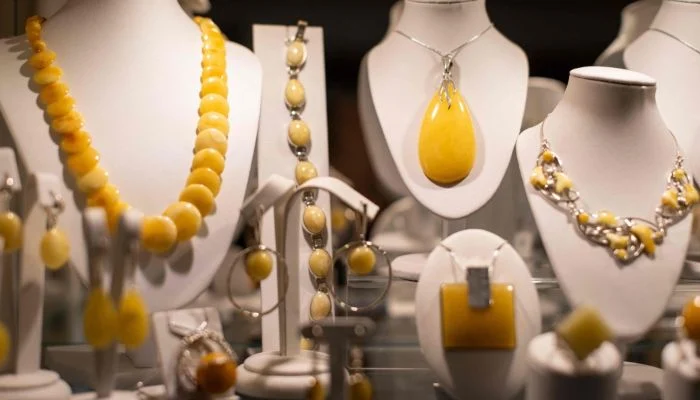
Gdansk’s old town, especially Mariacka Street, is brimming with jewelry crafted from authentic Baltic amber. Young Polish artisans are reimagining this traditional gemstone, blending longstanding history with modern fashion trends. They leverage a mix of classic hand tools—drills, sanders, sandblasters, and saws—paired with cutting-edge technology at the Gdansk Academy of Fine Arts, situated along Poland’s Baltic coast, renowned worldwide as the hub of amber craftsmanship.
In virtual reality labs, students design jewelry by assembling digital models that rotate, spin, and converge, aiming to produce the next wave of sought-after pieces. “From day one, we learn the entire design process, applying our creativity and exploring diverse technologies,” remarked 26-year-old student Martyna Golinska. She favors CNC milling, a technique prevalent in aerospace, automotive, and medical manufacturing.
For her peer Paulina Smigiel, the key challenge is translating artistic ideas into precise digital commands machines understand. “If we get it right,” she explains, “no extra mechanical work is needed.” These designs include rings, necklaces, bracelets, masks, crowns, and more—often made from amber intertwined with gold, silver, or titanium, whether milled or 3D-printed. Some pieces feature solitary stones, while others combine multiple elements, resulting in minimalist or intricate aesthetics that challenge traditional views of Polish amber jewelry often found in tourist markets.
Instructor Zuzanna Franczak emphasizes innovation, encouraging students to develop their own methods of mixing traditional techniques with emerging technologies. “It’s an evolving field, and artificial intelligence is already making an impact,” she notes.
Their creative output is displayed in catalogs and at special exhibitions at the Amber Museum along the historic “Amber Road,” a vital maritime trade route from ancient times that transported “Baltic gold” to the Mediterranean. Amber, formed about 40 million years ago from conifer resin, often contains air bubbles, plant inclusions, or insects, each piece bearing a distinctive “fingerprint.” Its allure has been celebrated by figures like Ovid, Nero, and Pliny the Elder, and it remains prized in China for supposed healing properties and in Muslim cultures for prayer beads.
Throughout Gdansk’s old town, shops and markets dedicated to amber lure countless tourists daily. While traditional patterns still dominate, younger artists are pushing boundaries by experimenting with new styles and forms. “Old-fashioned holiday souvenirs still hold appeal,” explains 21-year-old student Dominika Afeltowicz, “but today’s youth seek fresh designs.” To attract this market, aspiring designers must push their creative limits, leveraging amber’s malleability and unique coloration—from deep reds to opaque whites—for innovative expressions.
Her mentor, Slawomir Fijalkowski, heads the experimental jewelry studio, guiding students through a process of continuous learning and reinvention. “We’re opening new doors,” he says, emphasizing the importance of balancing artistry with industry-ready design. These emerging talents are poised to thrive both in commercial fashion outlets and in art galleries worldwide, underscoring the universal appeal of good design rooted in a rich cultural heritage.
 ChatGPT
 Perplexity
 Gemini AI
 Grok AI