
Select Language:
Days after Iran effectively blocked shipping through the Strait of Hormuz following the US and Israeli strikes in late February, two Pakistani electric motorcycle shops 1,400 kilometers apart experienced a surge in inquiries.
Haseeb Bhatti, who customizes gasoline bikes with electric motors in Rawalpindi, reported a 70% increase in sales in March. Ali Gohar Khan, who runs a seven-year-old electric motorcycle franchise with multiple locations across Pakistan, said this recent spike in sales is the most significant he’s ever seen.
“People are worried that they might not have access to petrol in the near future,” Khan explained. The crisis in the Middle East has driven global fuel prices higher, adding to Pakistan’s economic pain amid inflation and a sluggish post-pandemic recovery. Since Pakistan imports almost all of its oil through the Strait of Hormuz, rumors of shortages spread despite government assurances of supply.
Approximately 40% of Pakistan’s gasoline consumption goes to fuel the country’s 30 million two-wheelers and auto rickshaws, which dominate the roads where cars are considered a luxury and public transportation is limited.
Industry experts and analysts believe this situation will accelerate Pakistan’s shift toward electric vehicles (EVs). The country’s push for EV adoption could be further boosted by abundant solar energy, which offers a cost-effective and cleaner alternative for charging e-bikes.
Switching to EVs could reduce oil imports, help strengthen foreign exchange reserves, and cut emissions in the country, which was ranked among the most polluted worldwide in 2025. Following an 18% price increase last week, Pakistani households earning median wages now spend about 31% of their daily income on a liter of petrol—second only to a few nations tracked by globalpetrolprices.com and Our World in Data.
“I earn 30,000 rupees a month. That barely covers my family of six. How am I supposed to afford filling my bike?” said Zahoor Ahmed, a security guard in Karachi.
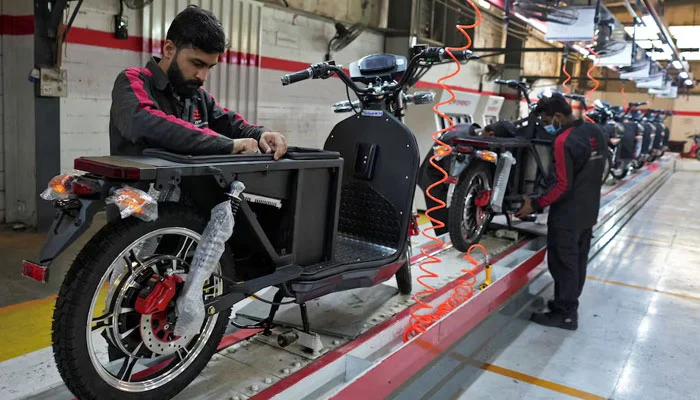
With rising fuel costs, more workers and students are turning to electric bikes. Last year, higher gasoline prices nearly tripled EV sales, reaching 90,000 units, or about 5% of all two-wheelers sold, according to consultancy Renewables First. This year, EVs have topped 10% of monthly two-wheeler sales for the first time. Experts predict this trend will grow because charging an electric bike can be up to 10 times cheaper than refueling with gasoline.
“Noori Shahbaz, a housewife buying an electric bike in Lahore, remarked, ‘Given the escalating gas prices due to the war, EVs seem like a very practical option. Everyone should consider getting one,’” in a country where women riders are still a small but growing segment.
Subsidies and Financial Incentives
A typical electric two-wheeler costs around 250,000 rupees—more than half the average yearly income and 56% higher than the popular gasoline-powered Honda CD 70, priced at about 160,000 rupees.
In February, the Pakistani government launched the Pakistan Accelerated Vehicle Electrification (PAVE) program, offering a subsidy covering 20% of the cost and interest-free loans for the remainder. The initiative targets electric bikes and auto rickshaws.
The response has been strong, with roughly 270,000 applications—almost seven times the initial phase target set to end in June, according to Finance Ministry advisor Adnan Pasha. The government aims to finance 2 million EVs over five years, funded through existing fuel levies. Pasha estimates that electrifying these vehicles could save nearly half a billion dollars annually in fuel imports.
Many Pakistanis have also turned to solar power following energy tariff hikes driven by IMF policies in 2023, purchasing low-cost Chinese panels for home use. The government plans to leverage this solar boom to promote EV adoption further.
“Using solar energy can lower electricity costs at charging stations and make home charging more affordable,” Pasha noted. Ammar Habib, an adviser to Pakistan’s power minister, added that increasing EV use could also benefit the national grid by stabilizing demand and easing solar power’s daytime volatility.
Predominance of Chinese Brands
Much of Pakistan’s EV adoption mirrors its solar revolution, with Chinese companies leading the charge. Brands like Yadea and Jinpeng, along with locally assembled e-bikes featuring batteries from firms like AIMA and Sunra, are expected to meet rising demand.
BYD, the Chinese electric vehicle giant, is planning to expand. It has already launched cars in Pakistan via local partners and is working with HUBCO Green to expand charging infrastructure nationwide, aiming eventually to increase passenger car sales.
The government encourages local companies to build more charging stations, especially since last year’s 45% reduction in power tariffs for charging stations has made EVs more economically attractive. However, ongoing conflicts and logistical challenges—such as a lack of local expertise and scalable charging infrastructure—pose risks to Pakistan’s EV goals, warned Ahtasam Ahmad, an energy finance expert at Renewables First.
Reliable maintenance networks are critical, as EVs are more susceptible to potholes—common on South Asian roads. In India, poor road conditions have led to service delays for e-scooters, and similar issues could affect Pakistan if after-sales support remains weak.
“Once Chinese brands flood the market, it might seem promising on paper, but without robust after-sales service, consumer trust in EV technology could suffer,” Ahmad added.
 ChatGPT
 Perplexity
 Gemini AI
 Grok AI