
Select Language:
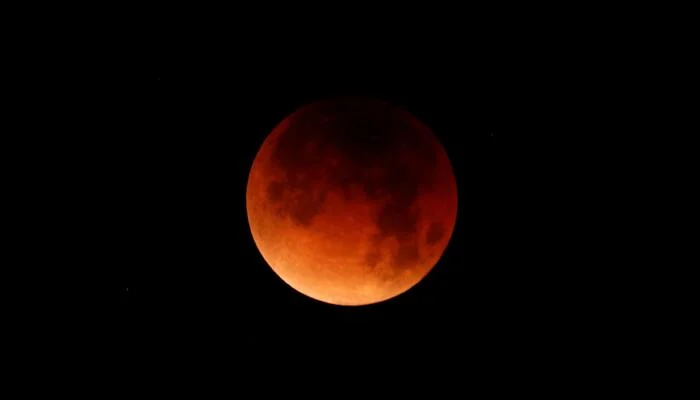
A rare blood moon viewed through a telescope. — Reuters/File
A total lunar eclipse is happening this afternoon (Tuesday), turning the full Moon a reddish-orange hue as Earth positions itself directly between the Sun and the Moon.
This astronomical event occurs during a full Moon when Earth’s shadow falls onto the Moon’s surface. As sunlight passes through Earth’s atmosphere, blue light gets scattered, while red and orange wavelengths continue forward, giving the Moon its deep red coloration during the eclipse.
According to the Pakistan Meteorological Department (PMD), the eclipse will start with the penumbral phase at 1:44 p.m. Pakistan time, when the Moon enters Earth’s outer shadow and begins to dim slightly. The partial eclipse begins at 2:50 p.m., with totality starting at 4:05 p.m. The eclipse hits its peak at 4:34 p.m., and totality starts to end at 5:03 p.m. The entire event will conclude by 7:23 p.m.
Since most of the eclipse occurs during daylight in Pakistan, it might not be visible to many in the country. However, some viewers may catch the later stages in the evening, depending on moonrise times and local weather conditions. The PMD mentioned that the eclipse will be partially visible from various cities.
Globally, the full eclipse will be visible in the evening across eastern Asia and Australia, overnight across the Pacific, and before sunrise in parts of North and Central America as well as the far western regions of South America. Viewers in central Asia and large sections of South America will only see a partial eclipse. The event won’t be visible from Africa or Europe.
Experts emphasize that a lunar eclipse can be safely observed with the naked eye when the Moon is visible in the sky. Using binoculars or telescopes can offer a more detailed view, especially in areas with minimal light pollution.
 ChatGPT
 Perplexity
 Gemini AI
 Grok AI