Select Language:
Houston: They’re drinking smoothies, taking photos with their phones, dealing with email crashes, and fixing busted toilets—astronauts are just like us.
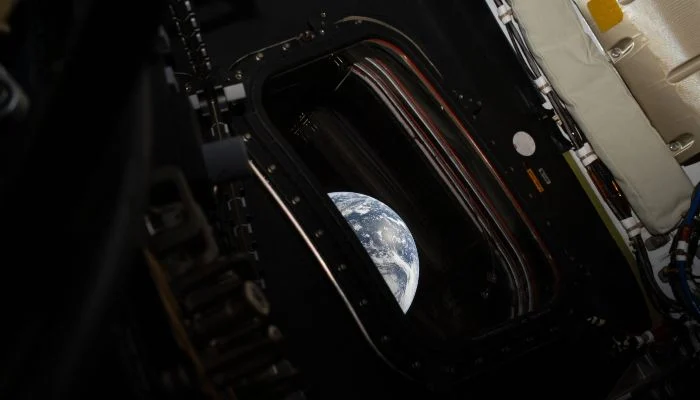
The four team members speeding through space toward the Moon are on a mission unlike any before, but they’re also still dealing with everyday stuff— all while floating around in a space that’s roughly as big as two minivans.
Mission specialist Christina Koch, the first woman to go on a deep space voyage, said prepping for the 10-day trip was like planning a camping adventure.
“It symbolizes togetherness and something a bit extraordinary,” she explained in a NASA video.
Their supplies include 58 tortillas, 43 cups of coffee, barbecue beef brisket, and five kinds of hot sauce.
And one toilet that had an issue.
It’s the first time deep-space astronauts have had a fully functional toilet on board: during the Apollo missions in the ‘60s and ‘70s, astronauts used waste bags that they left on the lunar surface.
Thankfully, Koch fixed the problem, joking during a Thursday Q&A with U.S. media, “I’m proud to call myself the space plumber.”
She added, “I think it’s probably the most important piece of equipment on board. We all breathed a sigh of relief when it was working fine.”
Sleeping “like a bat”
The toilet is in a small, noisy cubicle—requiring ear protection to use.
But it’s also “the one place where we can feel alone for a moment,” Canadian Astronaut Jeremy Hansen said during a Canadian Space Agency video preview.
The Artemis crew also quickly ran into email issues: commander Reid Wiseman mentioned he was having trouble with Microsoft Outlook.
“We have two Outlook accounts, and neither is working,” he said on NASA’s live stream.
Mission Control personnel back on Earth fixed the problem—proof of how crucial IT support is.
To stay ready for the mission’s various tests, maneuvers, and scientific observations, the astronauts follow a strict sleep schedule.
They sleep in tethered bags to keep from floating around inside the capsule.
Wiseman described Christina Koch sleeping head-down in the middle of the vehicle—like a suspended bat—and said, “It’s more comfortable than you might think.”
Childlike joy
There are no rest days in zero gravity: the crew has 30 minutes of exercise built into their day.
They use a “flywheel” device, similar to a yo-yo, which allows for cardio activities like rowing and resistance exercises like weighted squats and deadlifts.
Working out is essential—microgravity eases stress on bones and muscles but leads to significant weakening without proper precautions.
NASA recently updated its policy to allow smartphones on flights, enabling crews to capture moments and share images with loved ones—space agency head Jared Isaacman shared on X in February.
Despite the precision required for their mission, the astronauts embrace childlike fun: Hansen, seated horizontally, said floating feels “like being a little kid.”
Victor Glover, the first person of color to orbit the Moon, shared that much of his excitement came during launch.
“It’s a professional ride, but inside, you want to shout and cheer,” he said.
 ChatGPT
 Perplexity
 Gemini AI
 Grok AI