Select Language:
The pace of AI development is intense and relentless. Industries have already embraced its potential, and leading AI companies are actively working to make it accessible to students through exclusive deals and discounts. Now, the focus appears to be shifting toward providing universal access to AI tools for all citizens, starting with ChatGPT Plus.
In the United Kingdom, Peter Kyle, the Secretary of State for Science, Innovation, and Technology, reportedly discussed the possibility of granting all UK residents access to ChatGPT Plus. This would mark one of the first instances of such an initiative for OpenAI, following unconfirmed reports that the United Arab Emirates was also considering offering free ChatGPT Plus access to its citizens earlier this year.
ChatGPT Plus costs $20 per month and offers several benefits, including priority access during peak times, higher usage limits for the latest AI models, expanded voice chat, image generation, document analysis, advanced research capabilities, and the ability to create custom AI bots, known as GPTs. The free version remains accessible to all internet users without requiring an account.
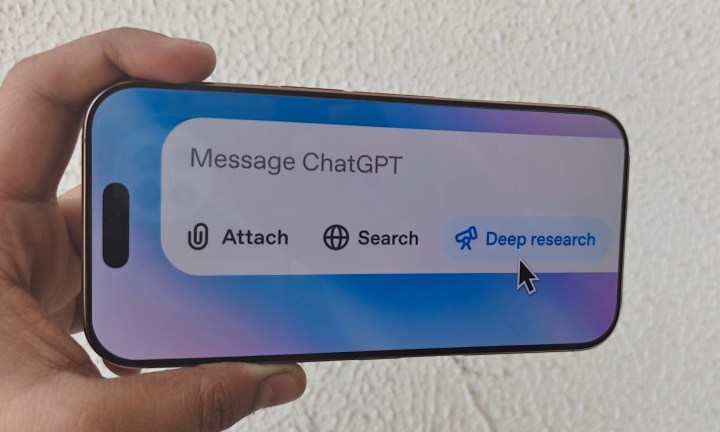
A recent image highlights the Deep Research feature available within ChatGPT, which enhances the AI’s ability to perform intricate research tasks.
Interestingly, Peter Kyle was reportedly skeptical about the idea, mainly because the program could entail costs reaching up to £2 billion. The Guardian cited anonymous sources familiar with a meeting in San Francisco, where these discussions took place. Kyle has also engaged in several meetings with OpenAI CEO Sam Altman over the past year. Despite reservations about the financial aspect, Kyle has praised ChatGPT as an incredibly useful tool. The UK government has already partnered with OpenAI in various ways, including agreements to develop web-based chatbots for government services and civil agencies, as well as plans for a secure digital wallet system that integrates driver’s licenses and other verified IDs.
Offering widespread access to advanced AI tools is a proven way to broaden adoption and build confidence. Given that the UK is one of the largest markets for ChatGPT, introducing free or discounted access to all citizens—even temporarily—could significantly accelerate AI integration into everyday life. Such initiatives are not unprecedented; OpenAI earlier launched a two-month free access period for students in the US and Canada, and in August introduced a lower-cost subscription tier called ChatGPT Go in India, priced at approximately $4.57 per month, offering core Plus features.
Other major players are also adopting similar strategies. Google, for example, provides Gemini Pro, a premium AI subscription costing $20 per month, free to students in the US, Japan, Indonesia, Korea, India, and Brazil. Google also bundles this service with purchases of certain smartphones, like the Pixel 10 series. Additionally, Google’s premium AI benefits are available through the Google One subscription, which includes 2TB of cloud storage, illustrating how tech giants are working to make AI tools more accessible—sometimes subsidized or bundled with other services.
In India, a government official recently called for all citizens to be granted free access to cutting-edge AI tools, including ChatGPT, Gemini, and Claude. Meanwhile, the UAE government has open-sourced its Falcon AI model for public use and adaptation, and Elon Musk’s xAI has released its Grok 2.5 model as open-source software, signaling a move toward democratizing AI technology worldwide.
The trend toward broadening access to sophisticated AI tools continues to grow, with policymakers and corporations recognizing the strategic advantages of making these resources widely available. As these efforts expand, the potential for AI to become an integral part of daily life and work grows exponentially.
 ChatGPT
 Perplexity
 Gemini AI
 Grok AI