
Select Language:
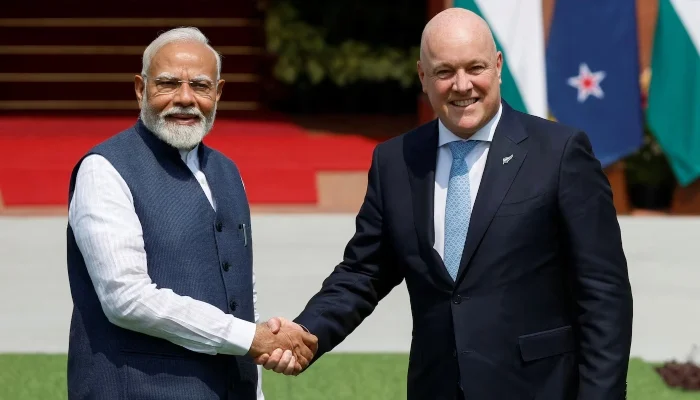
New Zealand and India announced a free trade agreement on Monday, streamlining exports for New Zealand and opening up access to India’s massive and rapidly growing market, projected to reach NZ$12 trillion ($7 trillion) by 2030. The deal cuts tariffs or removes them entirely on 95% of New Zealand’s exports to India, with more than half becoming duty-free immediately upon signing.
The agreement also includes provisions for around 1,667 temporary work visas annually in sectors like healthcare, education, technology, and engineering, to address skills shortages. Additionally, New Zealand will offer 1,000 working holiday visas each year, matching Australia’s deal with India.
Prime Minister Christopher Luxon highlighted the significance of the agreement, emphasizing India’s status as the world’s most populous and fastest-growing large economy, which creates opportunities for jobs, exports, and overall growth for New Zealand.
The two nations anticipate signing the treaty during the first half of 2026. Todd McClay, New Zealand’s trade minister, stated that this deal positions the country on par or better than other nations trading with India and is expected to generate thousands of jobs and billions of dollars in additional exports. India’s government confirmed the agreement but did not release further details, with India’s trade minister set to speak to the media later Monday.
This treaty fulfills an election promise from New Zealand’s ruling National Party, made during the 2022 election, to finalize a free trade agreement with India within its first term. However, approval in parliament is not guaranteed; New Zealand First, a coalition partner, plans to oppose the deal, citing concerns over immigration and dairy market provisions. Winston Peters, leader of NZ First, argued the pact gives away too much on immigration and does not secure enough benefits for New Zealand.
Trade between the two countries in 2024 totaled NZ$3.14 billion, mainly comprising Indian pharmaceuticals and New Zealand’s forestry and agricultural products, including wool, logs, and apples.
 ChatGPT
 Perplexity
 Gemini AI
 Grok AI