Select Language:
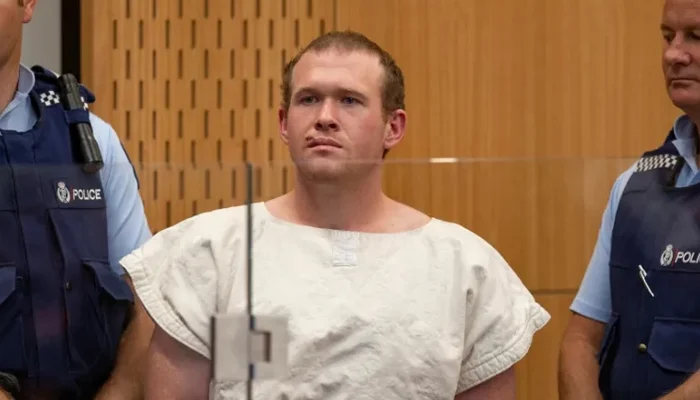
A white supremacist who killed 51 Muslim worshippers at two mosques in New Zealand seven years ago argued Monday that he was mentally unfit when he pleaded guilty. Local media reported that he is now seeking to overturn his conviction in a New Zealand court. Brenton Tarrant, 35, appeared via video link in a Wellington court to challenge his guilty pleas.
Tarrant, an Australian citizen, carried out the attack in March 2019 during Friday prayers at Christchurch’s mosques, marking the deadliest mass shooting in New Zealand’s history. Prior to the assault, he released a racist manifesto, used military-style semi-automatic weapons, and livestreamed the shootings on Facebook using a head-mounted camera.
Initially, Tarrant denied all charges and was preparing for trial, but he changed his pleas to guilty a year later on 51 counts of murder, 40 counts of attempted murder, and one charge of terrorism. He claimed that intense prison conditions had worsened his mental health while awaiting trial and rendered him unable to make rational decisions, according to a report in the New Zealand Herald.
“I did not have the necessary mental state or mental health to make informed decisions at that time,” Tarrant told the court. “The true issue is, did I truly understand what I was doing or what might be a good idea? No, I didn’t. I was making choices, but they weren’t voluntary or rational due to the conditions in prison.”
The lawyers representing Tarrant have had their identities and names protected by court order and could not be reached for comment. A court document indicated that the Court of Appeal will examine whether Tarrant was legally capable of making rational decisions when he entered his guilty pleas, citing his claim that prison conditions were torturous and inhumane.
Tarrant is serving a life sentence without the possibility of parole — the first time New Zealand’s courts have handed down such a sentence. The appeal is scheduled to last five days, concluding on Friday. Should the court deny his request to rescind his guilty pleas, a subsequent hearing will address whether his sentence should be altered. If his appeal is accepted, the case will be sent back to the High Court for a new trial on the charges.
 ChatGPT
 Perplexity
 Gemini AI
 Grok AI