
Select Language:
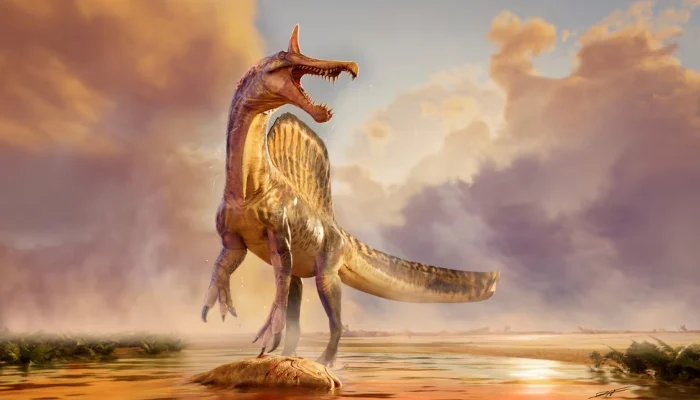
A fossil discovery in a remote part of Niger’s Sahara Desert has unveiled a previously unknown species of Spinosaurus, one of the largest terrestrial carnosaurs known to science. This new species is distinguished by its sizable, curved head crest and jaws filled with interlocking teeth, ideal for catching slick fish.
During its time, roughly 95 million years ago in the Cretaceous Period, it roamed a lush, forested inland landscape and waded into rivers to hunt fish, much like modern herons. One researcher described it as a “hell heron,” considering its impressive length of about 40 feet (12 meters) and weight estimated between five to seven tons.
Its striking silhouette featured an elongated, crocodile-like snout, a tall, curved cranial crest resembling a scimitar, and a sail-like structure along its back. The new species was named Spinosaurus mirabilis—‘mirabilis’ meaning “astonishing”—to highlight its remarkable crest. Similar to its cousin, Spinosaurus aegyptiacus, described in 1915 from fossils found in Egypt, S. mirabilis shared traits like long dorsal spines forming a sail and a skull adapted for piscivory.
However, compared to the Egyptian species, S. mirabilis had a larger crest, a more elongated snout, more widely spaced teeth, and longer hind limbs. The crest was likely used for display rather than as a weapon, as it appears too fragile and was composed of solid bone without air sacs, instead possibly sheathed in keratin and brightly colored for attracting mates or asserting dominance.
Two fossils of S. mirabilis were uncovered in what is now Jenguebi, a secluded site surrounded by desert dunes. The discovery required a strenuous journey from Agadez through the harsh desert terrain over three days—often getting stuck in the sand. The fossils included parts of three skulls, other bones, and remains of various creatures.
This find challenges previous views that Spinosaurus was entirely aquatic. Fossils of its Egyptian relative, S. aegyptiacus, indicated a fully marine lifestyle, but since the new fossils were found far inland—about 300 to 600 miles from the nearest ocean shoreline—it suggests S. mirabilis was a shallow-water predator, not a true aquatic diver. Paleontologist Paul Sereno, lead author of the study published in Science, called this discovery “the coup de grâce for the aquatic hypothesis.”
The species’ retracted nostrils allowed it to sink most of its snout underwater to stealthily hunt fish while breathing easily. Its teeth, arranged in both upper and lower jaws for interdigitation, formed an effective fish trap capable of piercing and holding onto slippery prey. These features indicate it was highly specialized for catching fish, making it a superior piscivore over other non-arsenic-based predators of its time.
Unlike the coast-hugging fossils of S. aegyptiacus from Egypt and Morocco, which led scientists to believe Spinosaurus was a marine creature, the inland discovery of S. mirabilis shows a lifestyle centered around shallow waters. Sereno’s team described the find as “the coup de grâce,” definitively settling debates about the dinosaur’s habitat preference.
The expedition team set out from Agadez in 2022, traveling for nearly three days across desert sands. After a challenging journey that included getting stuck in the dunes, they uncovered parts of three skulls and various bones, alongside fossils of other ancient species.
Long overshadowed by T. rex in popular imagination, Spinosaurus is now experiencing renewed interest and recognition. Sereno dubbed this resurgence “a dino-happening.”
 ChatGPT
 Perplexity
 Gemini AI
 Grok AI