Select Language:
A team of scientists in China has developed a new polymer thermoelectric film that greatly enhances the performance of flexible thermoelectric materials. This breakthrough could open new doors for energy-harvesting applications in wearable devices and Internet of Things sensors.
The innovative material, created by researchers at the Institute of Chemistry, Chinese Academy of Sciences, achieved a thermoelectric figure of merit (zT) of 1.64 at 343 Kelvin — setting a new record among flexible thermoelectric materials operating within the same temperature range. This development marks a significant step forward in overcoming long-standing performance limitations of polymer-based thermoelectric materials, as detailed in a recent publication in the scientific journal Science.
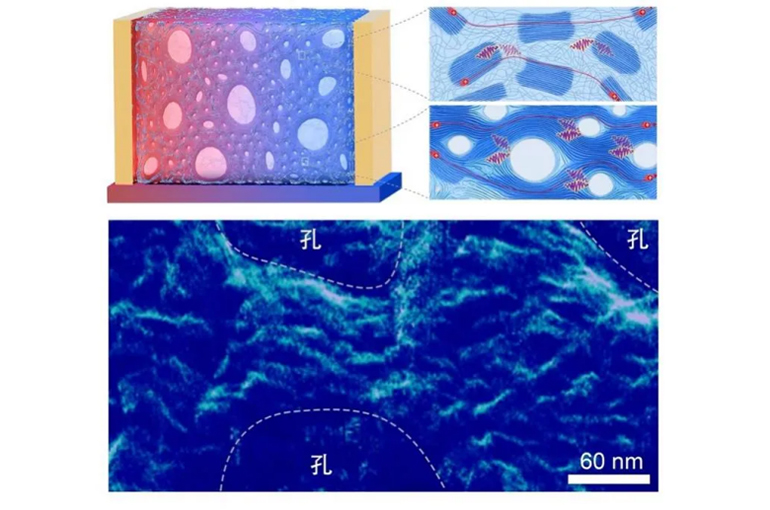
Led by Zhu Daoben and Di Chongan, the research team engineered irregular hierarchical-porous thermoelectric polymer (IHP-TEP) films using a precisely controlled phase separation technique during the critical transition phase. This method allows for simultaneous regulation of thermal conductivity and charge transport, resulting in notable improvements in the performance of flexible thermoelectric materials.
Thermoelectric materials have the unique ability to convert heat directly into electricity, offering a promising avenue for conserving energy and reducing emissions by recycling waste heat. When integrated into clothing or worn on the body, flexible thermoelectric devices can harness heat generated during daily activity, producing clean electricity without noise or pollution.
Historically, polymer thermoelectric materials lagged behind inorganic counterparts in terms of zT performance, limiting their practical use. However, these newly developed IHP-TEP films achieved a maximum zT value of 1.64 at 343 Kelvin, surpassing the previous record of 1.28 for polymer thermoelectric materials in the same temperature range.
For efficient thermoelectric performance, materials must combine high electrical conductivity with low thermal conductivity, enabling rapid charge flow while minimizing heat loss. The figure of merit, zT, serves as a comprehensive measure of these properties.
Unlike many high-end thermoelectric materials that require complicated manufacturing processes, the new IHP-TEP films can be produced on a large scale and at a low cost through spray-coating technology. The underlying design principles are adaptable to various polymer systems, paving the way for scalable, sustainable thermoelectric generators ideal for wearable and portable energy-harvesting solutions, the researchers noted.
 ChatGPT
 Perplexity
 Gemini AI
 Grok AI