Select Language:
On December 15th, a local life sciences company successfully completed China’s first human implantation of a fully integrated brain-computer interface (BCI) device equipped with an internal battery. This significant milestone marks a major advancement in the country’s efforts to transition BCI technology from experimental research to practical clinical use.
The system was developed by a research team based in Shanghai, with surgical implantation carried out by medical professionals from Huashan Hospital, affiliated with Fudan University. Currently, only a select few global companies, including Neuralink founded by Elon Musk, have developed comparable fully implanted BCI systems.
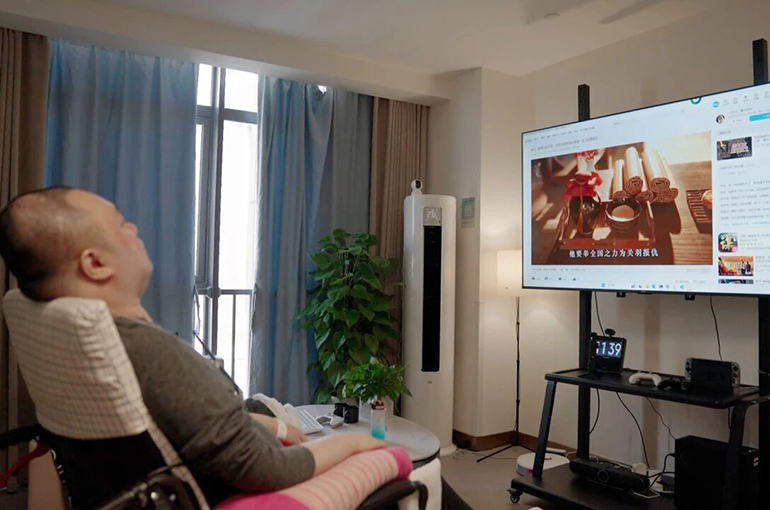
The recipient, a high-level paraplegic unable to move below the shoulders, was able to control their thoughts to operate the device just five days post-surgery, according to reports at the recent annual conference of the Brain-Computer Interface and Interaction Branch of the Chinese Neuroscience Society. After undergoing systematic training, the patient achieved a brain-control decoding rate of 5.2 bits per second in standard tests—considered among the best in the world, said Mao Ying, president of Huashan Hospital.
Previous BCI models required external battery modules and devices to supply power, increasing infection risks and reducing convenience. The new fully implanted device integrates the battery inside the body, with wireless power and data transmission capabilities, enabling patients to eliminate external equipment altogether, explained Tao Hu, founder and chief scientist of the company. To further improve safety, the company has also developed a subcutaneous battery placement in the chest and optimized the deep brain stimulation architecture to keep heat-producing components away from the brain tissue.
Since its founding four years ago, the company has performed 54 BCI implant procedures on humans, including this latest case. Plans are underway to register for clinical trials next year in order to accelerate product commercialization.
As BCI technology evolves from the lab into clinical practice, tangible benefits are emerging for patients with motor impairments, helping them regain function and decode speech signals more effectively, Mao noted. The ongoing integration of artificial intelligence with BCI is anticipated to reshape humanity’s future in profound ways.
Further collaboration between engineering teams and rehabilitation experts, along with refining technology based on real-world clinical needs, remains a key focus area. This approach aims to enable personalized BCI solutions tailored to various conditions and scenarios, according to Shan Chunlei, director of the Institute of Rehabilitation at Shanghai Jiao Tong University School of Medicine.
 ChatGPT
 Perplexity
 Gemini AI
 Grok AI