Select Language:
A few weeks ago, Apple unveiled the iPhone 16e, which garnered significant attention due to its new network chip. The C1 represents Apple's first self-designed modem integrated into an iPhone, moving away from complete dependence on Qualcomm. Nonetheless, there were apprehensions regarding its competitiveness.
The team at the well-known speed testing site, Ookla, evaluated the new modem and discovered that it surpassed Qualcomm's modem found in the iPhone 16 in several critical areas. This assessment spanned roughly two weeks and examined the performance across AT&T, Verizon, and T-Mobile networks.
In general, the iPhone 16e showed enhanced performance compared to the iPhone 16 when connected to AT&T and Verizon services, whereas the opposite was observed on T-Mobile. Ookla attributes the latter's results to T-Mobile's extensive nationwide 5G standalone (SA) network, which the C1 modem has only limited compatibility with.
When the Going Gets Tough, C1 Rises
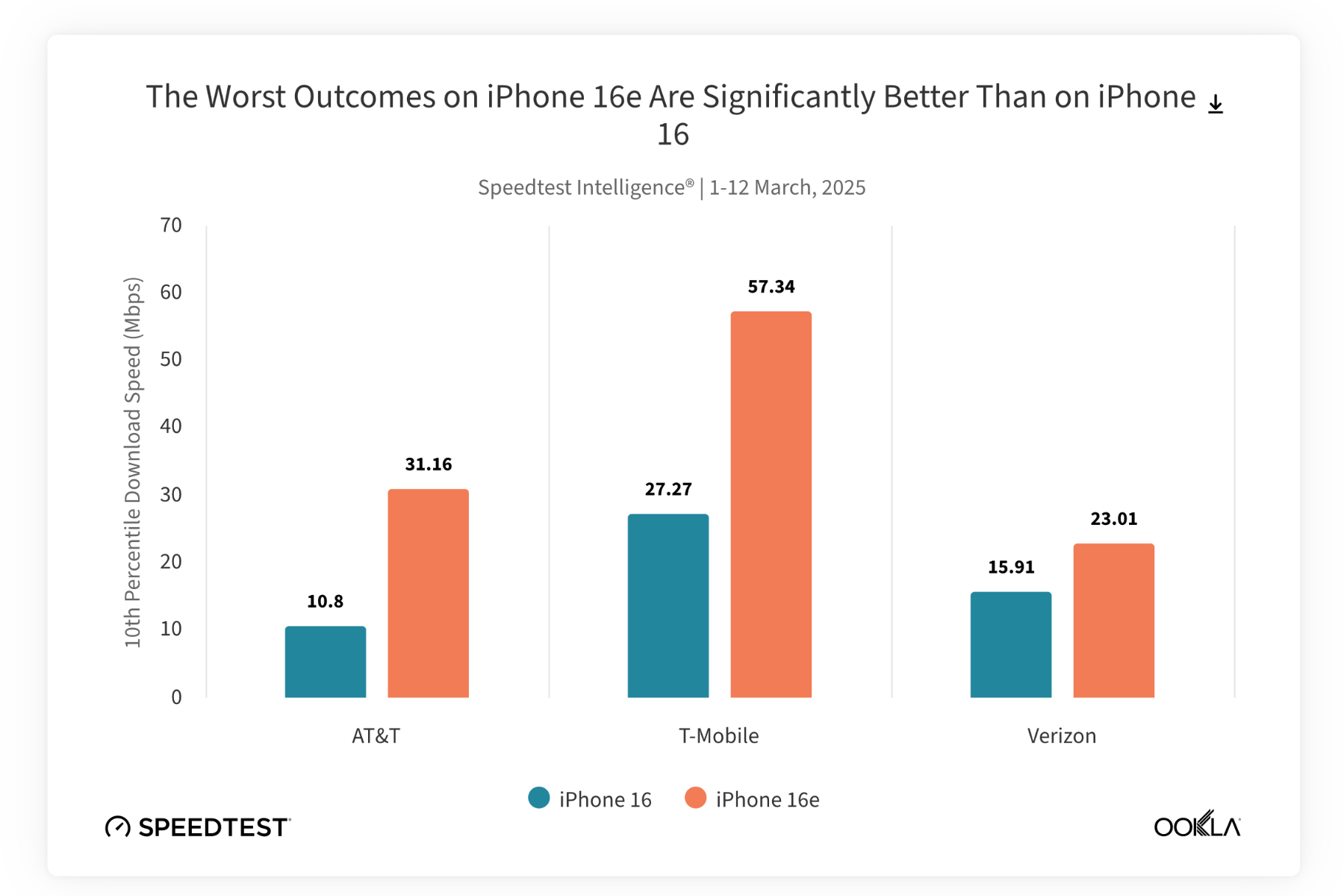
Notably, in situations where network performance is challenged, the iPhone 16e outperforms the iPhone 16 that relies on a Qualcomm modem. Ookla refers to these challenging conditions as the bottom 10% of performance brackets. In tests conducted across various carriers, the C1 modem consistently surpassed its Qualcomm counterpart in download speeds.
On T-Mobile's network, for example, the iPhone 16e achieved download speeds of 57.34 Mbps, while the iPhone 16 fell behind at 27.27 Mbps. Even at the upper end of its capabilities, the iPhone 16e reached peak downlink speeds ranging from 140 to 264 Mbps, more than adequate for activities like social media, streaming, and cloud gaming.
However, the scenario changes when looking at peak download speeds, as the Qualcomm modem can handle the faster mmWave 5G technology. Nonetheless, Ookla emphasizes that the lower percentile scores offer a more reliable measure of overall user experience than peak speeds, which can be skewed by network conditions.
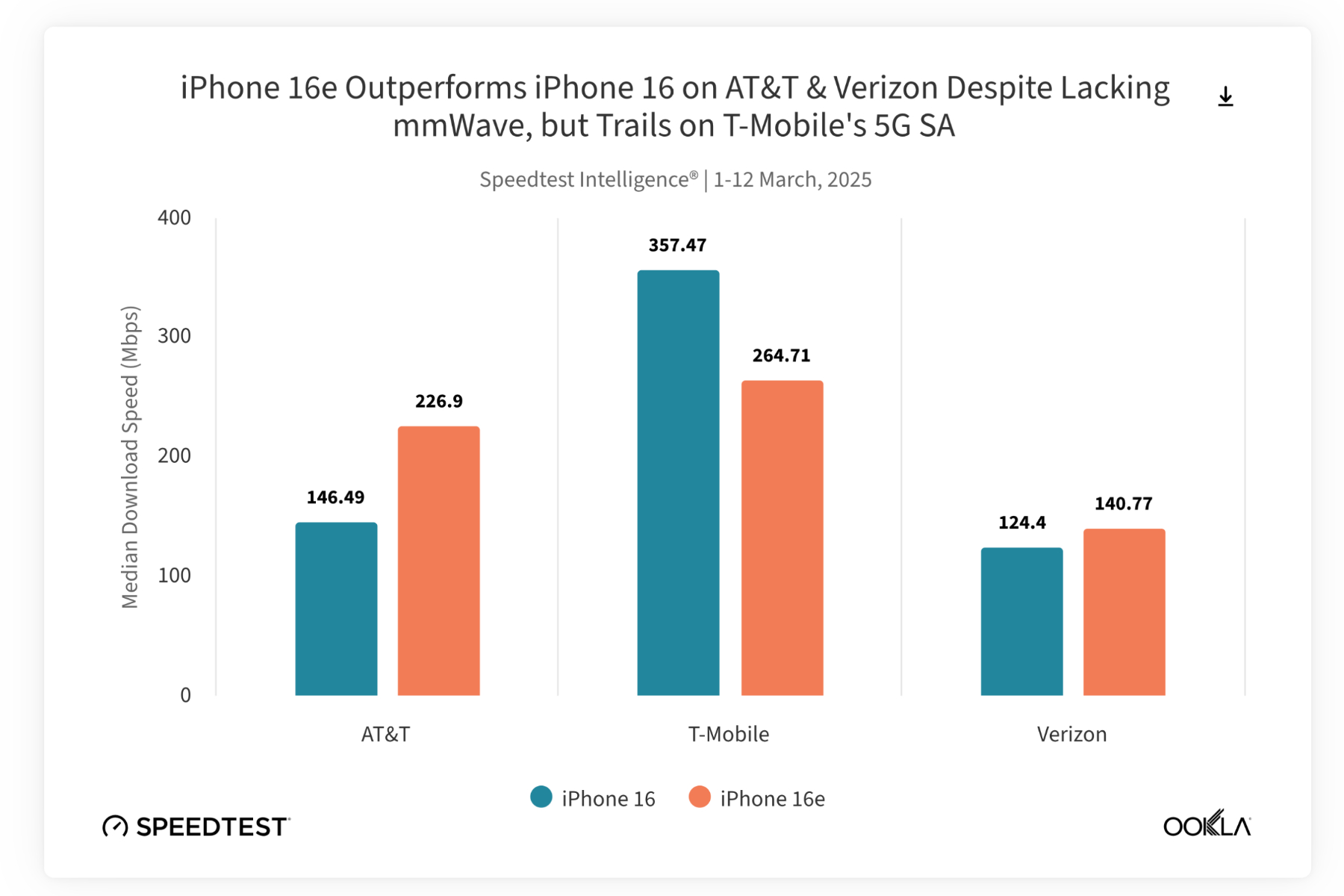
“Performance during the lowest 10% of conditions often provides a better representation of overall quality of experience (QoE) than the top 90%, which can be affected by deployments in mmWave areas and may show diminishing returns,” according to the report.
Notching a Second Surprise Win
In another surprising outcome, the iPhone 16e pulled off yet another win over the iPhone 16 regarding critical uplink speeds. Once again, on Verizon and AT&T networks, Apple’s C1 modem outperformed the Qualcomm variant, achieving upload speeds as much as 38% faster.

These results are impressive, especially given that Qualcomm's modem provides superior downlink carrier aggregation compared to Apple’s C1. Despite lacking uplink carrier aggregation support, the iPhone 16e still managed to outperform the iPhone 16 in upload metrics.
An additional independent evaluation revealed that the C1 modem is more energy-efficient than Qualcomm’s model, which translates to less strain on battery life. Furthermore, the compact design of Apple’s in-house modem allows the iPhone 16e to offer a larger battery capacity compared to the more expensive models in the iPhone 16 lineup.
 ChatGPT
 Perplexity
 Gemini AI
 Grok AI