Select Language:
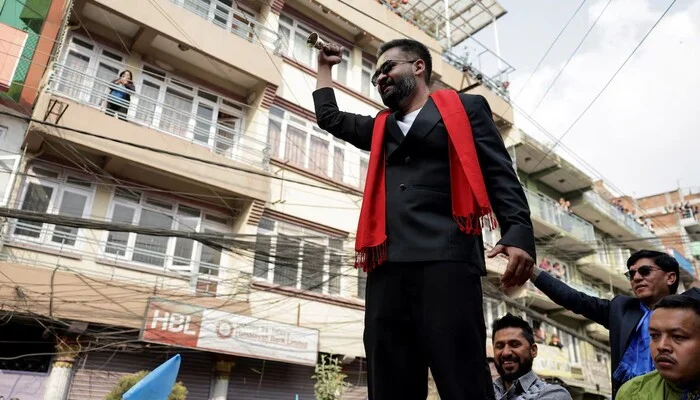
Balendra Shah, a musician-turned-politician and the prime ministerial hopeful for the Rastriya Swatantra Party (RSP), rings a bell, which serves as the party’s emblem, during an election campaign in Kirtipur, Kathmandu, Nepal, on February 28, 2026. — Reuters
Shah’s growing popularity is fueled largely by social media and his strong connection with young voters. The RSP’s manifesto emphasizes job creation and economic development. Counted results from the election commission indicate that around 100 seats are led by his party, far ahead of main competitors, with final outcomes for all 165 directly elected seats and 110 proportional representation seats expected soon.
The Nepali Congress, now in second place, has already conceded defeat. Analysts predict that the RSP’s substantial lead makes it likely Shah will lead the upcoming government. “Balen Shah’s immense popularity has even led to buses heading to Kathmandu bearing stickers that say, ‘Heading to Balen’s city,’” noted Bipin Adhikari, a constitutional law professor at Kathmandu University.
If Shah wins, it would mark a remarkable rise for a figure who initially gained fame through rap music criticizing Nepal’s establishment and leveraged that support to attain high political office.
Shah’s appeal partly stems from his tenure as Kathmandu’s mayor, where he prioritized urban infrastructure improvements, waste management, and healthcare services. However, he has also been criticized, including by Human Rights Watch, for allegedly using police to seize property from street vendors and landless citizens. He stepped down as mayor in January to run for national office and did not respond to interview requests or questions from Reuters.
Unlike seasoned political veterans from older generations, Shah largely avoids mainstream media. Instead, he maintains a prolific social media presence, with over 3.5 million followers on platforms like Facebook, allowing him to directly engage with younger voters. “What makes Balen unique is his ability to connect with youth through brief messages on social media, but becoming prime minister won’t be an easy task,” said independent political analyst Puranjan Acharya.
Born to a father practicing traditional Ayurvedic medicine and a homemaker mother, Shah displayed an early talent for poetry, which evolved into a passion for rap influenced by American artists such as Tupac Shakur and 50 Cent. After earning an undergraduate degree in civil engineering in Nepal, he pursued a master’s in structural engineering in southern India, all while establishing himself as a rap star. His songs often tackle Nepal’s ruling class and resonate with many in a nation where about 20% of 30 million people live in poverty.
One of his most popular songs, “Balidan” (Sacrifice), released in 2019, has garnered over 12 million views on YouTube. The lyrics include: “Let me speak, sir, it is not a crime, / Let me open my mind, I am not a curse to the palace, / My mind is not bad, I am not afraid to speak the truth.”
In December, Shah joined the RSP, led by former TV host Rabi Lamichhane, as its prime ministerial candidate. The party’s platform includes creating 1.2 million jobs, reducing forced migration, and boosting Nepal’s per capita income from $1,447 to $3,000—more than doubling the country’s economy to a $100 billion GDP—and providing healthcare insurance for all within five years.
Looking ahead, analysts believe Shah’s success as leader will largely depend on assembling a talented team to overhaul Nepal’s sluggish, corrupt bureaucracy. “He needs capable advisors and support systems—without them, he risks becoming ineffective, like wood attacked by termites,” Acharya warned.
 ChatGPT
 Perplexity
 Gemini AI
 Grok AI